





























by Anna-Maria Nunez Vega, Burkhard Voigt and Rahul Khanna, Grain Technik, India
The pivotal role of grain temperature in managing insect infestation and preserving the quality of stored grains is well-established. Maintaining control over temperature is critical, given the inability of insects to thrive outside the range of 13–35°C. High-temperature treatments, while effective in pest control, often come at the cost of quality degradation, particularly in the context of heat treatments using hot air. Cooling grain has emerged as an effective strategy against insects, leading to the development of grain chillers that can be used in scenarios where ambient conditions are insufficient for cooling.
The application of grain chilling involves utilising a mobile refrigeration system that independently regulates the temperature and relative humidity of the aeration air, ensuring optimal conditions for stored grains. Existing studies suggest that maintaining grain temperature below 20°C significantly reduces the development rate of insects compared to higher temperatures.
Relevance of grain temperature
Chilling grain below 15°C within a week has proven effective in preventing most insect species from completing one life cycle, making chilled aeration a technically feasible strategy for reducing or eliminating the need for chemical control of stored product insects. Economically, grain chilling emerges as a viable solution for chemical-free pest control, even in tropical conditions, with operational costs found to be lower than alternative methods such as aeration with ambient air and fumigation combined. Noteworthy is the broader impact of grain chilling, extending beyond pest control to mitigate quality losses in cereal storage and prevent product deterioration.
To contribute further insights into the practical implications of these findings, our study investigates the influence of storage methods (chilling, aeration, and traditional bags) and the resulting temperature on corn infestation in a continental climate near New Delhi, India. This research aims to bridge existing knowledge gaps and enhance our understanding of the interplay between storage conditions and insect infestation in a real-world context.
Materials and methods
In this study, we employed a carefully designed experimental setup to investigate the influence of storage methods on corn infestation in a continental climate near New Delhi, India (Figure 1). The key components of our setup included two small-scale silos, a chiller, an aeration fan, product stored in a standard gunny bag, and laboratory equipment (Figure 1).

The silos used in the experiment were locally purchased and made from high-density polyethylene (HDPE), each with a capacity of one m³. To ensure proper insulation, the silos were equipped with 19mm thick closed-cell nitrile rubber, with a thermal conductivity of 0.037 W m−1 K−1. The silo bottom was cut open in-house and fitted with an aeration floor opening covering the full floor area of 1.2m². Both silos were equipped with three PT100 sensors each, mounted in the silo centre and continuously measuring the product temperatures in the bottom, middle, and top layers, respectively. One PT100 sensor was fitted in the middle of the storage bag.
The chiller was specially designed for the study, featuring a semi-hermetic 2-cylinder compressor (Bitzer 2FES-3Y-40S) with a rated cooling power of 10.9 kW, operating at a condensing temperature of 40°C and an evaporating temperature of 10°C. The refrigerant used is R-407C, and the chiller is powered by a 3-phase 415V/50Hz supply. Capacity control is achieved through a Danfoss variable speed drive, and a 2kW electric heater with Radix thyristor control provided additional temperature control. The chiller system is managed by a PLC (Siemens S7-1200) and an HMI (Siemens KTP700), both supported by a battery-buffered UPS. The maximum air flow of the chiller is 1800 m³/h, with a constant air flow and static pressure of approximately 350 m³/h and approximately 300 Pa maintained during the trials.
The supply fan is a Hicool CFBE-225S (Centrifugal fan, forward-curved, rated voltage 230 V / 50 Hz), and the condenser fan is a Ziehl- Abegg FN035-VDK.0F (Axial fan with external rotor motor, rated voltage 3 * 400 V / 50 Hz). The chiller was fitted to supply cold air to silo A via a hose at the silo bottom. Silo B was connected accordingly to an aeration fan, supplying approximately 350 m³/h of ambient air to the silo. Both silos were set up next to each other inside a hall to assure identical ambient conditions.
The silos and the storage bag were loaded with freshly harvested, pre-cleaned, and dried corn of the same batch, purchased from Bihar, India. Different storage conditions were applied to the silos, with one following conventional industry practice utilising aeration and the other equipped with the grain chiller. The aeration fan ran for six hours daily, three hours in the late evening between 9pm and midnight and three hours in the early morning between 3am and 6am. The chiller in silo A was started automatically once any of the three temperatures measured in the silo reached 21°C and was henceforth running continuously until the target temperature of 15°C was reached in all layers.
Sampling was carried out at regular intervals using a Green Agritech Equipment sampling spear (Ambala, India) with a length of 1.5m and six openings. Insect damage was evaluated in the fresh product and after three and six months of storage. Moisture content was determined using the drying oven method according to ISO/DIS 712-2 standard.
Results and discussion
In the physical examination of the silo surfaces after three months, flying insects were already observable in the aerated silo B. Silo A showed no apparent changes compared to the trial start. After six months, only a few flying insects were observed in the headspace of silo A, and the appearance of the corn remained unchanged from the trial start (Figure 2A). In contrast, the conditions in silo B had significantly worsened, with the top layer covered in webbing, dead moths, and other insects (Figure 2B).

Figure 3 depicts the monthly average product temperatures in chilled silo A, aerated silo B, and the gunny bag. The temperature in the chilled silo dropped to the target temperature of 15 °C within a couple of days and remained at a constant low value with an average of 16.8 °C during the trial period. The product temperatures in aerated silo B, as well as the gunny bag, only reduced after four months of storage, with the average product temperature in the storage bag being the highest at 29.7°C, closely followed by silo B with an average product temperature of 29°C.
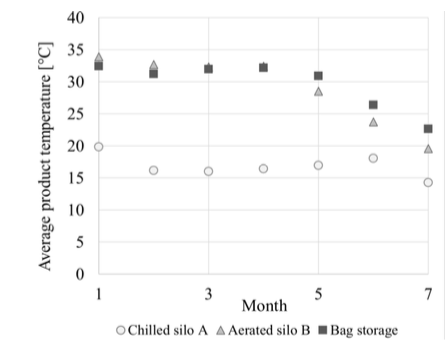
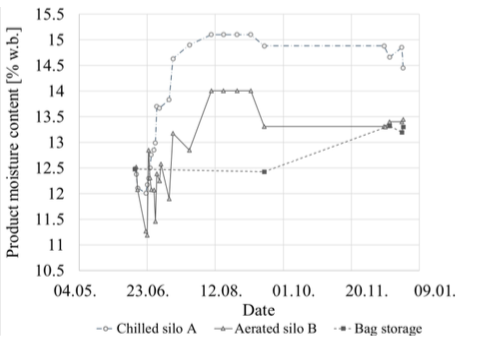
Figure 4 shows the changes in moisture content during the trial for the three storage methods. The product moisture was stable in the storage bag in the first three months of the trial until the drop in ambient temperature in autumn led to a decrease in product temperature and hence a slight increase in moisture content. The moisture content in the chilled silo A increased in the first month of the trial and remained stable at a value just below 15 percent. This increase in moisture content seen when using chilling is attributed to two factors.
The results of the quality determination revealed a notable difference in insect damage among the storage methods (Figure 5). A first tendency could already be seen after three months of storage when the number of insect-damaged kernels rose to 0.86 percent and 2.17 percent in the aerated silo B and the gunny bag, respectively. At the end of the trial, after six months, the product stored in the gunny bag exhibited over 22 percent insect-damaged kernels, the aerated silo displayed over five percent, while the chilled silo remained at zero percent. Both the samples from the aerated silo B, as well as the storage bag, showed significant insect damage, and at least six different species of living as well as dead insect pests could be identified.

Effectiveness of grain chillers
Our study highlighted the tremendous effect of the storage method on the product temperature, moisture content, and subsequent insect infestation in stored corn. It was demonstrated that a moderate but immediate temperature reduction could make a significant contribution to infestation control, with the corn showing no signs of insect damage even after six months of storage without any chemical pest control. In conclusion, this study underscored the effectiveness of using a grain chiller in preventing insect infestation, presenting a viable, sustainable alternative for preserving stored grains in a cost-effective manner.
Published in the January 2025 issue of Milling and Grain.