






























by Christian Lückstädt, Addcon GmbH, Bitterfeld-Wolfen, Germany
During the late 1980’s, it was discovered that pharmacological concentrations (1500 to 3000 ppm) of zinc oxide (ZnO) resulted in reduced post weaning diarrhoea (PWD) and increased growth in weanling pigs (Poulsen, 1989). It had been widely used at such dosages to control E. coli F4 infections. Several researchers have concluded however that one cannot assume a widespread antibacterial effect of ZnO, as the minimum inhibitory concentrations (MIC values) differ greatly both among and within bacterial species (Liedtke and Vahjen, 2012). This has been recently confirmed by Neath and colleagues (Table 1) who found minimum inhibitory concentrations of ZnO for E. coli, but also for S. typhimurium, S. suis or S. aureus to be above 31 mg×ml-1, thus proving no direct efficacy (Neath et al., 2021).
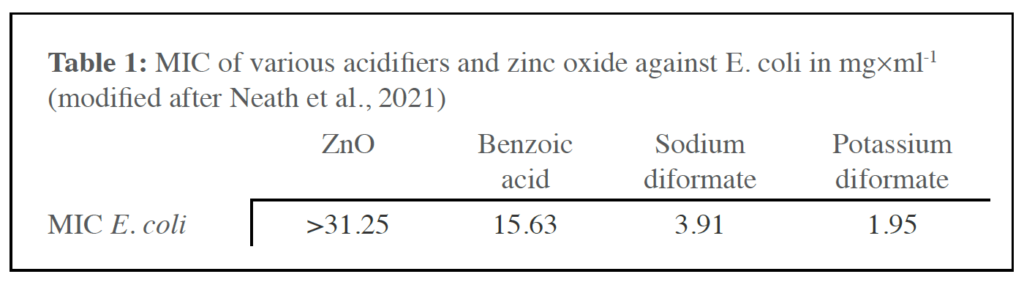
Its impact against certain E. coli strains for instance is understood rather as a stabilizer of the intestinal microbiota and preventing attachment of pathogenic bacteria to the intestinal villi, which can prevent many problems associated with weaning diarrhoea. Unfortunately, as Zn is poorly absorbed, it becomes highly concentrated in the manure. To minimize the risk of environmental pollution, European authorities have reduced the maximal Zn concentration authorized in pig diets. Since June 2022, pharmacological doses of ZnO are no longer authorized in the EU. Therefore, alternative strategies and/or additives to manage PWD have had to be found. The topic still catches the interest of the scientific community; indeed, a headline from the June 2024 issue of FeedNavigator states that “a consortium led by the Roslin Institute will study the effects of the ban on zinc oxide in the UK pig diets, focusing on antimicrobial resistance and animal health”. Many authors have directed their research efforts towards the use of acidifiers – as this group of commonly used feed additives has proved successful since the ban on antibiotic growth promoters came into force in the EU in 2006.
Some authors have also claimed that “…Dietary acidifiers can actually become the most common and efficacious alternative solution to antibiotics, in order to improve health status and performance in pigs” (Papatsiros and Billinis, 2012). One such acidifier, potassium diformate (Formi, KDF, ADDCON), achieved approval by the EU as a non-antibiotic growth promoter for use in pig diets – the first product to receive such approval (Øverland, 2001). It was therefore unsurprising that diformates had been tested in diets containing low levels of ZnO. This report gives an overview of the usage of potassium diformate (KDF) and sodium diformate (Formi NDF – both substances produced and registered by ADDCON, Germany) in zinc oxide-reduced piglet diets.
Data from published trials that included diformates in diets for post-weaning piglets were collected from the literature. The final dataset contains the results of 10 documented trials with diformate (inclusion rates ranging from 10 to 18 kg/t) and low levels of ZnO (average 100 ppm). These studies were carried out under both commercial and institutional conditions and included more than 1,068 post-weaning piglets. The dataset was subjected to a meta-analysis, covering the effects of diformates on diarrhoea percentage and feed efficiency. A P<0.05 value was considered significant.
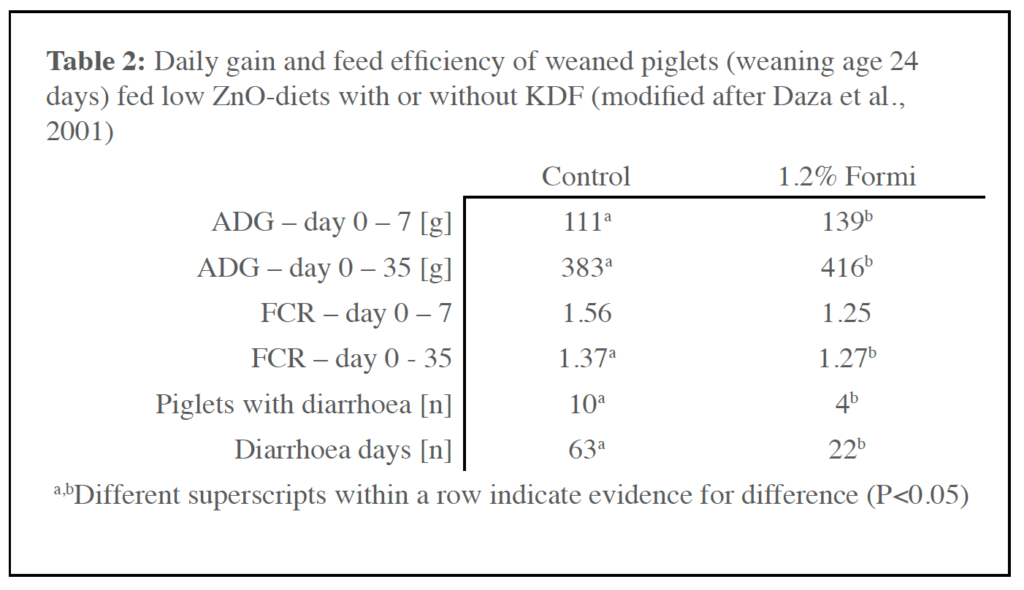
One of the first results on the usage of KDF in low zinc oxide diets was published in 2001 (Daza et al., 2001). The authors used diets with 150 ppm zinc oxide in the control, while the treatment diet contained an additional 1.2 percent KDF. In three successive trials in Spain, with 56 piglets per trial, the effect of potassium diformate on the performance and health status of weaned piglets (Pietrain x Dalland) was observed (Table 2). Data showed a significant performance enhancing impact of the dietary diformate, as well as a clear impact on PWD.
Another report from Spain (Portocarero-Khan, 2006) compared a pharmacological dosage of ZnO (2500 ppm) with 1.2 percent dietary KDF (Table 3). Both additives improved weight gain against a negative control significantly, while only the diformate had a significant impact on feed efficiency against the control. It was concluded by the authors that improved gut health due to the use of KDF in the critical period after weaning was the cause of the improved production performance achieved.

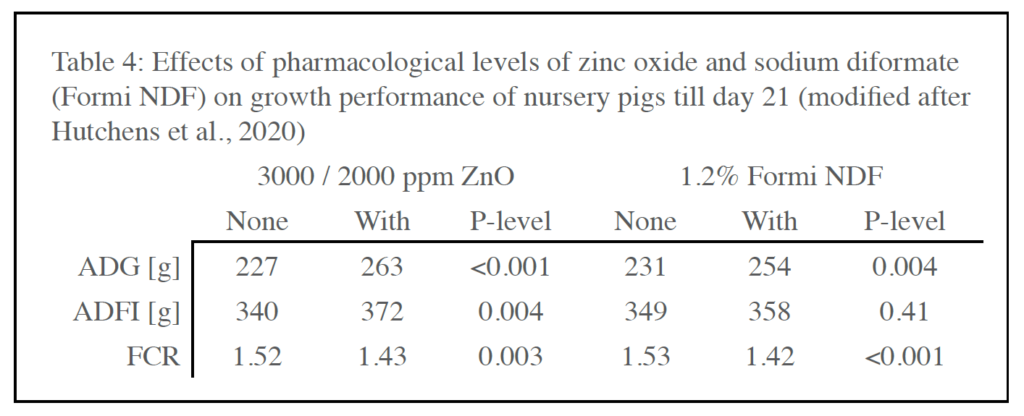
Similar experience was reported by authors from the Kansas State University (Hutchens et al., 2020). The researchers were running a trial to assess alternatives to replace the use of zinc oxide in nursery pig diets. ZnO was added till day seven at 3000 ppm and thereafter until three weeks post-weaning at 2000 ppm. From day 0 to 21, the pigs fed added ZnO had an improved (P<0.05) average daily gain (ADG), average daily feed intake (ADFI), feed efficiency (FCR), and increased day 21 bodyweight (BW) compared to those fed the negative control with only 110 ppm Zn (Table 4). On the other hand, adding sodium diformate (1.2 percent) significantly (P<0.05) improved ADG, FCR, and BW. In summary, dietary addition of ZnO or NDF independently improved nursery pig performance. The authors concluded that the addition of an acidifier with or without ZnO could be a useful practice to improve nursery pig growth performance.
The aforementioned trials are among those from which the data was used for the comparison analysis – consisting of 10 trials, with or without diformate inclusion in post-weaning piglet diets.
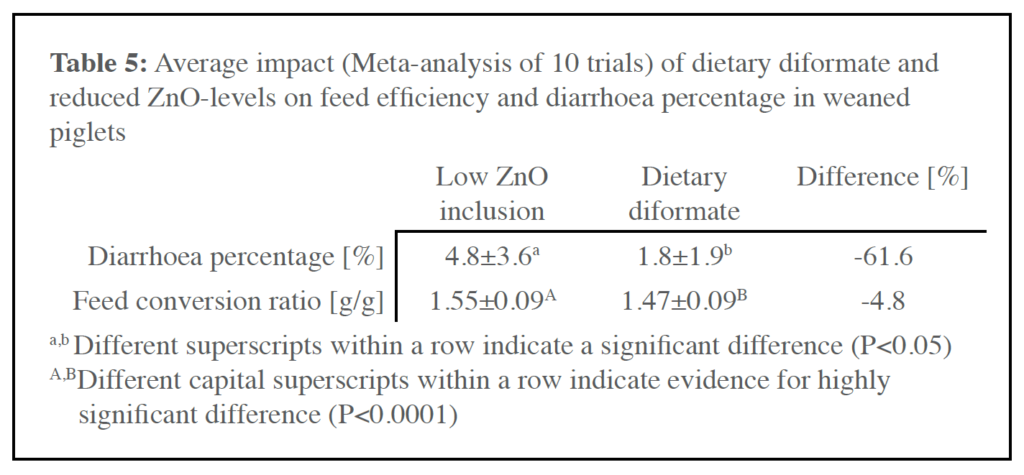
Across the whole dataset, diarrhoea percentage in post-weaning piglets fed with diets containing low ZnO-levels was significantly (P=0.023) influenced by the inclusion of dietary diformates. The diarrhoea percentage was reduced by more than 61 percent in the diformate-fed piglets: from 4.8 percent in the ZnO-fed piglets, compared to only 1.8 percent (Table 5) in the diformate-fed piglets. Furthermore, feed efficiency was highly significantly (P<0.0001) improved by 4.8 percent (FCR with ZnO: 1.55; with diformate: 1.47) in piglets fed with diformate – either Formi or Formi NDF.
This is in agreement with the findings of a previous holoanalysis of 59 pig trials with potassium diformate inclusion, which had on average a significantly improved FCR by 4.2 percent against negative controls (Lückstädt and Mellor, 2010). In the context of the above data, the acidifiers Formi (potassium diformate) or Formi NDF (sodium diformate) can play a vital part in zinc oxide reduction strategies (Hutchens et al., 2020) and may further help in improving feed efficiency in post weaning piglet production – thus playing an important part in worldwide sustainable pig production approaches.
Published in the August 2024 issue of Milling and Grain.