




























by Roger Gilbert and Darren Parris, Milling and Grain
Ocrim Open Days 2026 brought more than 250 flour milling professionals from 21 countries to Cremona, Italy, for factory tours, an inauguration and a gala dinner, alongside its two-day conference, ‘Wheat, Flour and … 2026’. This feature reports the technical talks on food quality, efficiency, maintenance and machinery innovation; Stefano Mazzini’s keynote on culture; addresses by owners Alberto and Sergio Antolini as the company opened its third factory; a look inside three factories; and the arrival of SPIGO, Ocrim’s new mascot.
Cremona, the Italian city that gave the world the Stradivarius violin, knows a thing or two about craftsmanship. In September it welcomed more than 250-plus flour millers from 21 countries to Ocrim Open Days 2026 – a gathering that combined factory tours, an inauguration, a gala dinner and a celebration of Ocrim’s culture with a two-day technical conference, ‘Wheat, Flour and … 2026’, hosted at the Politecnico di Milano campus in the city.
The morning session, themed ‘Nutrition and Food Quality: The Contribution of the Milling Industry,’ was moderated by Eloisa Martino of Ocrim’s marketing and communication team. She opened with a reflection on food and human identity, reminding delegates that food is far more than sustenance: it reflects our culture, values and traditions, and understanding how quality food is produced has never been more important.
Ms Martino then guided the audience through four talks following food quality along the supply chain: Sara Boussetta (University of Pavia) on healthy eating; Ilva Licaj (Alushi) (University of Sannio) on cereals, legumes and consumer perceptions; Fabio Bressan (Ocrim/SIMA) on raw material storage; and Ocrim’s Marco Galli on how choices from seed selection to milling shape safety, nutrition and quality. Mr Galli’s presentation opens our coverage.
Also reported here are the talks on efficiency, maintenance and machinery innovation, Stefano Mazzini’s keynote on culture, the owners’ addresses and the factory visits.
Marco Galli: From seed to safe food
Producing safe, nutritious and consistently high-quality food begins long before grain reaches the mill.
For the milling industry, the challenge is to use technology throughout the supply chain to manage the natural variability of agricultural raw materials while preserving – and wherever possible increasing – their value, says Marco Galli, Technology Manager at Ocrim SpA, during ‘Wheat, Flour and … 2026’, the two-day conference at the heart of Ocrim Open Days 2026 in Cremona, Italy.
Presenting ‘From Seed Selection to Processing: Creating a Safe and Healthy Product,’ Mr Galli traced the journey from seed and field through storage, selection and milling to the production of ingredients destined for food manufacturers and consumers.
“Everything starts from the seed, everything starts from the wheat kernel, but there are many steps in between,” he says. “It is not simply a transformation; we must create value. If we don’t create value, there’s no point in getting involved.”
At the heart of that challenge is variability.
Grain arriving from the field inevitably differs in size, weight, moisture and other characteristics, affecting milling yield, energy use, rheological and nutritional properties, food safety and ultimately operating costs.
“The product from the field, no matter how hard we try, will never be the same,” he says.
“We must use technology to manage it – manage it because all downstream stages are impacted by it. So, this is the goal, managing in order to keep producing correctly. The challenge is not to produce differently it is to manage an unknown.”

What nature provides
Selection technologies provide one means of reducing that variability. Cleaning and separating grains according to size, density and other characteristics can produce more homogeneous raw materials and reduce losses throughout subsequent processing.
The issue is becoming increasingly important as consumer demand expands beyond conventional flour. Seeds are increasingly incorporated whole into bakery and other food products, making purity, uniformity, nutritional quality and physical appearance important considerations.
Mr Galli highlighted the scale of avoidable grain losses, telling delegates that 25 percent of cereal production is lost because it is inadequately stored or managed through the supply chain.
Measurement and data management therefore become fundamental tools.
“Let’s always remember that what cannot be measured cannot be managed, cannot be improved and cannot be maintained,” he says.

Creating more value from the kernel
For millers, greater uniformity in incoming grain can mean fewer process adjustments, reduced intervention and improved yields.
“Any industry, when it knows the incoming product and has a consistent product, performs better,” he says. “So, the goal is to have a product as consistent as possible in order to obtain better results.”
Grain blending can play an important role by allowing cereals that might not individually meet a specification to be combined into a blend capable of achieving the required final quality. This can be achieved with a continuous mixing loop based on protein measurements, and can recover usable raw material, reduce losses and improve economic returns.
Technology can also help millers respond to growing consumer interest in nutrition.
“The point is that technology does not create nutritional value, but it can help concentrate these nutritional values, maximising their characteristics,” he adds.
The principle is particularly relevant to modern milling because nutrients are distributed differently throughout the grain kernel. Milling and particle-size separation can therefore be used to create fractions with differing nutritional and rheological properties.
“Fundamentally, the mill doesn’t refine; the mill extracts something that is already inside the kernel,” says Mr Galli.
By managing individual flour streams and combining fractions appropriately, one mill can produce flours tailored to different applications – from pizza to pasta – while similar principles can be employed to develop products with specific nutritional characteristics.

Food safety starts in the field
Food safety formed the final major element of Mr Galli’s presentation, with a warning against treating it simply as a compliance exercise.
“If we think we can reduce food safety to compliance with a series of bureaucratic rules, we’re done for,” he says.
Instead, responsibility must extend throughout the complete supply chain.
“No single step of the supply chain guarantees food safety; food safety must be a mandatory step in every single stage of the supply chain,” he says. “It originates and begins with the grain, from the field and continues through every step up to the packaged product.”
Ultimately, Mr Galli argued, technology should enable processors to preserve the inherent qualities of agricultural raw materials while managing their inevitable variability.
“The quality of a product begins long before the process, and every step of the supply chain plays an important role in preserving and improving the raw material, and in converting this raw material into a nutritious, sustainable, and safe product,” he concluded.
Fabrizio Baccinelli: Beyond efficiency
Efficiency is no longer simply about producing more, Fabrizio Baccinelli, Sales Director at OCRIM SpA, told delegates at ‘Wheat, Flour and … 2026’, the conference at the heart of Ocrim Open Days 2026 in Cremona. Geopolitical instability, supply chain disruption, energy volatility, climate pressures and shifting raw material quality have made the environment far less predictable than in 2016, he said.
“Efficiency is no longer only about producing more effectively,” he says. “It is also about being able to bridge a gap and continue producing when conditions become more difficult.”
Rigid versus adaptive efficiency
Wheat, logistics, energy, and maintenance and spare parts increasingly determine plant profitability, he explained, together accounting for well over 90 percent of the production cost of flour.
Mr Baccinelli distinguished between ‘rigid efficiency,’ which minimises cost and maximises output in a stable environment, and ‘adaptive efficiency’, built on flexibility and resilience. “The question is no longer only how efficient a plant is,” he says. “The question becomes how efficiently a plant can react when something unexpected happens.”
Grain cleaning offered one example: a system tuned to a narrow specification can become constrained by higher impurity levels, while a flexible one provides options. Ocrim’s modular milling concept, which divides equipment into separate operational groups so that some maintenance can proceed without a full shutdown, likewise cuts downtime and labour requirements without adding capacity.
Cost of ownership and people
Automation, he said, should support operators rather than replace expertise, and purchasing decisions should look beyond capital cost to energy, maintenance, spares and reliability. “A plant that is cheaper to buy is not necessarily cheaper to own,” he notes.
People, however, remained the most important asset. As experienced operators retire, preserving knowledge is becoming a strategic priority. “You can have the most advanced technological plant and still have the plant underperforming if the people operating it do not have the right information, skills and expertise,” he says. “The human being remains at the centre.”
“We cannot control prices, geopolitical events or weather. But we can control how we prepare for these changes,” he concluded.
Simone Pedrini: Building a smarter maintenance strategy
Effective mill maintenance is not simply about preventing machinery from breaking down.
It requires operators to understand the criticality of individual machines, select the appropriate maintenance approach for each component and use measurable performance indicators to determine whether the strategy is actually improving plant efficiency.
That was the central message from Simone Pedrini, Head of the Design Office at Ocrim SpA, during ‘Wheat, Flour and … 2026’, the conference at the heart of Ocrim Open Days 2026 in Cremona, Italy.
Addressing the subject of strategic maintenance, Mr Pedrini outlined four approaches – corrective, preventive, predictive and prescriptive maintenance – and explained why millers should regard them as complementary tools rather than simply progressing from a supposedly inferior system towards an increasingly sophisticated one.
“Strategic generally means something tied to a long-term objective that we must achieve with limited resources that we must use wisely,” he says.
Four approaches, rather than one solution
- Corrective or reactive maintenance is the simplest approach: intervention takes place only once a component has failed. This can result in unplanned downtime and makes spare-parts requirements harder to anticipate.
For inexpensive, easily replaced components whose failure has little consequence for production, corrective maintenance can remain an entirely rational choice.
- Preventive maintenance instead schedules intervention according to time or production throughput. This is the approach typically specified in Ocrim operating manuals and allows mills to plan downtime, spare-parts inventories and production requirements.
The danger here is ‘over maintenance.’ Generic maintenance intervals may result in components being replaced before the end of their useful life.
- Predictive, or condition-based, maintenance moves from schedules towards evidence about the actual condition of equipment. Sensors measuring parameters including temperature, vibration and noise, together with oil analysis, can indicate when components are approaching the end of their operational life.
“It lets me intervene when the machine part is actually in crisis. That is, at the end of its operational life,” says Mr Pedrini. The approach requires investment in sensors, wiring, data recording and analysis, however, and is most useful where deterioration can be measured reliably.
- Prescriptive maintenance goes further, combining large quantities of operational data with advanced analysis – potentially including artificial intelligence – to optimise maintenance for particular components and failure modes.
Matching maintenance to criticality
The practical challenge, therefore, is deciding where each method belongs.
Mr Pedrini suggested evaluating components according to two questions: how serious would the consequences of failure be and how predictable is that failure?
Low-criticality, unpredictable failures may justify corrective maintenance. Predictable failures with relatively low consequences lend themselves to preventive schedules.
Highly critical but predictable components can justify investment in condition monitoring and predictive maintenance.
Where a component is both highly critical and difficult to predict, the answer may lie elsewhere, for example maintaining appropriate spare-parts stocks or redesigning the plant with modular systems that prevent a single failure from stopping the entire production process.
“There is no single method that is optimal for every machine,” he says. “We must analyse our plant once it’s running, break it down, find which building block best fits each part, and build our maintenance strategy.”
Measuring whether maintenance works
Once that strategy is established, performance must be measured.
Mr Pedrini highlighted ‘Overall Equipment Effectiveness’ (OEE), which combines availability, performance and quality. A plant achieving high individual scores can still lose considerable productive potential once the three factors are combined. An OEE of 89 percent, for example, effectively means that for every potential 100 tonnes of production, 11 tonnes are being lost through downtime, underperformance or quality-related losses.
Data alone, however, is not sufficient. Operators must also be trained to recognise emerging problems and have access to the information required to maintain equipment correctly.
“This information must be shared. I’ve spoken with maintenance people who didn’t know where the manuals are and some had never seen them,” he says. “These are documents that must be shared, because they contain very important information on how to interact with the machine.”
Ultimately, strategic maintenance means investing selectively rather than automatically adopting the most technologically advanced option.
Sergio Manfredini: Smarter milling
Milling machinery innovation is no longer simply about processing more product in less time.
Increasingly, the objective is to create intelligent, connected plants that use sensors, automation and advanced control systems to cut energy consumption and waste while delivering more consistent product quality.
That was the message from Sergio Manfredini, a technologist at Ocrim SpA, when addressing the 250-plus delegates attending ‘Wheat, Flour and … 2026’, the conference at the heart of Ocrim Open Days 2026 in Cremona, Italy.
Presenting on the topic of Innovation in Milling Machinery: How to Improve Them to Increase Efficiencies in the Technological Process, Mr Manfredini drew on more than 30 years of experience with Ocrim, during which he has commissioned more than 60 plants covering wheat and corn milling, grain cleaning and feed production.
While milling remains fundamental to the agri-food supply chain, he pointed out that many of its basic processes remain rooted in technologies developed generations ago.
“Over the years, technological evolution has brought important changes to milling machines.
“However, there are still numerous opportunities to make them more efficient, sustainable and reliable,” he says.
For Ocrim, one of the biggest opportunities lies in intelligent sensor technology.
Temperature sensors monitoring rollers and bearings can detect conditions that might compromise flour quality or increase mechanical wear. Sensors installed on grinding rolls can also determine whether a roller mill is operating correctly in parallel and allow remote adjustments when temperatures fall outside established parameters.
Continuous monitoring is also reaching the milling process itself.
“Online granulometric analysis instruments allow continuous control over milling quality, as if we had a person continuously performing the sifting of the various passes,” says Mr Manfredini.
Yet, hardware alone cannot deliver an intelligent mill.
“Power is nothing without control. On their own, all the sensors, inverters and motors would provide no advantage, so they must be connected to a central ‘brain’ which, thanks to advanced software, can control every piece of data and manage every utility,” he adds.
Ocrim is incorporating decades of its technicians’ operational knowledge into this software, allowing control systems to increasingly replicate decisions previously dependent upon human experience.
“In the near future, there will be artificial intelligence managing these operations, but for now it is still the human who decides every function of the milling system,” says Mr Manfredini.
Looking beyond traditional milling machinery
Efficiency gains are not restricted to improving conventional milling equipment.
Technologies originating in other processing sectors are also changing how established operations are designed.
Mr Manfredini highlighted the introduction of optical sorting into Ocrim’s dry corn degermination process, replacing gravity tables traditionally used to separate germ from other broken fractions.
The potential savings are substantial. In a 10 tonnes/hour degermination plant, replacing five gravity tables with an eight-channel optical sorter reduces required aspiration by approximately 700 cubic metres per hour, equivalent to around 55kW of fan capacity.
The change also removed dozens of metres of large collection ducting and two filters, delivering benefits both in energy consumption and initial capital investment while reducing the requirement for continuous supervision by specialised operators.
For Mr Manfredini, the example demonstrates why machinery innovation needs to be considered across the entire processing system rather than simply at individual machine level.
“Innovating milling machines does not simply mean increasing production speed, but making the entire process more intelligent, precise, safe and efficient,” he says.
“The future of the milling sector will be increasingly oriented toward connected and automated plants, capable of leveraging Industry 4.0 technologies and artificial intelligence to continuously improve their performance.”
Stefano Mazzini: Culture at the heart of industry
In an industry preoccupied with machinery, efficiency, automation and capacity, Stefano Mazzini used his keynote at ‘Wheat, Flour and … 2026’, the conference at the heart of Ocrim Open Days 2026, to place a different word at the centre of Ocrim’s vision: culture. His talk challenged delegates to think beyond technology and consider the wider responsibilities of modern industry: preserving knowledge, nurturing people, safeguarding heritage and building stronger communities.
Mr Mazzini began with the dictionary definition of culture before expanding it into curiosity, learning, observation, generosity and preservation. Culture, he argued, is not an abstract concept but a practical foundation for business success and long-term sustainability, and he took an audience of experienced millers and business leaders through the many ways it has become embedded in Ocrim’s identity. The attention in the hall was palpable.
People and skills
One of the most compelling elements centred on professional development. Mr Mazzini highlighted Ocrim’s ‘In-With-For Italy’ initiative, which supports the integration and training of asylum seekers in Italy. By giving them the chance to acquire industrial skills and understand the values of milling, Ocrim is investing in the next generation of professionals while addressing future workforce challenges.
The audience responded particularly well to the company’s commitment to young talent. Mr Mazzini announced that Ocrim will fund a scholarship at the Politecnico di Milano for an exceptional student in the university’s Excellence Programme, reinforcing the belief that the future of milling depends not only on advanced technology but also on capable, motivated young people.
Heritage and responsibility
Another highlight was a new partnership to support the restoration and preservation of the Church of San Girolamo in Cremona. Industry, Mr Mazzini said, has a responsibility to protect beauty, history and shared cultural assets – a reminder that successful businesses can play a meaningful role in preserving the communities in which they operate.
Creativity, humour and a Topolino
Serious reflection was blended throughout with creativity and humour. Delegates heard the story behind ‘Ocrimopoly’, the custom board game created for Ocrim’s 80th anniversary, and of the ‘Ugly Duckling’ project that symbolises the company’s family-oriented approach to customer relationships.
The most unexpected moment was a new customer appreciation initiative: customers signing contracts during 2027 will receive a specially customised Fiat Topolino, reflecting both Italian ingenuity and Ocrim’s approach to building lasting relationships. The slides showed the little car in a choice of styles, from ‘sporty’ to ‘refined,’ and the good-natured humour with which the idea was presented drew smiles across the auditorium while reinforcing the message of partnership and belonging.
What made the keynote effective was its authenticity. Rather than dwelling on business achievements, Mr Mazzini presented a holistic vision of industry that encompassed people, education, art, heritage and community, delivered with confidence and a personal touch that created a genuine connection with an international audience.
His message was that profitability and purpose are not mutually exclusive: machines may drive production, but it is culture that gives industry its purpose. As delegates left to continue the technical programme, conversations kept returning to it – perhaps the clearest measure of the talk’s success.
Sergio Antolini: ‘To receive, to preserve, to transform and to pass on’
The gala dinner of Ocrim Open Days 2026 was held in the company’s brand-new third manufacturing facility on Via Milano, Cremona, where Ocrim President Sergio Antolini cut the ceremonial red ribbon. The investment of approximately EU€20 million adds around 20,000m² of manufacturing and logistics capacity, supporting Ocrim’s expanding global presence.
The moment was made more poignant by Mr Antolini’s heartfelt tribute to his brother Alberto, the company’s CEO, whose vision and leadership helped bring the ambitious project to life. Reflecting on the factory’s creation, he closed with words that resonated throughout the evening:
“The ribbon I cut today, therefore, does not separate a ‘before’ from an ‘after.’ It brings them together. And I like to think that, within this simple gesture, lies the true meaning of time: to receive, to preserve, to transform and to pass on. Thank you, Alberto. And thank you all for being here today to share this moment with us.”
The factory floor has yet to receive its machinery; instead the vast hall became a spectacular dining venue, with performers and a violin rendition of the Italian national anthem paying tribute to Cremona as the birthplace of Antonio Stradivari.
Factory visits: Three factories, no closed doors
Alongside the ‘Wheat, Flour and … 2026’ conference, Ocrim Open Days 2026 gave visiting millers something rarely seen in modern manufacturing: full access to three of the company’s factories.
The original factory, built in around 1945, was open for delegates to explore, offering a behind-the-scenes look at some of the world’s most recognisable flour milling machines.
The second production facility, alongside the city’s Porto Canale, is part of more than 30,000m² of manufacturing space dedicated to the design, manufacture and assembly of milling technology. Visitors were free to roam the workshops, assembly areas and specialist departments where roller mills, plansifters, bagging systems and palletising equipment are produced, and to visit the refluting department, where worn roll surfaces are given a new lease of life. Marco Galli, Fabrizio Baccinelli and colleagues from marketing and communication were on hand to guide them.
The third, on Via Milano, was still awaiting its production machinery when it hosted the gala dinner at which Sergio Antolini cut the ribbon.
What stood out was not just the scale but the openness: in an industry where manufacturing is often kept behind closed doors, Ocrim let millers from every corner of the world see exactly how its machines are made.
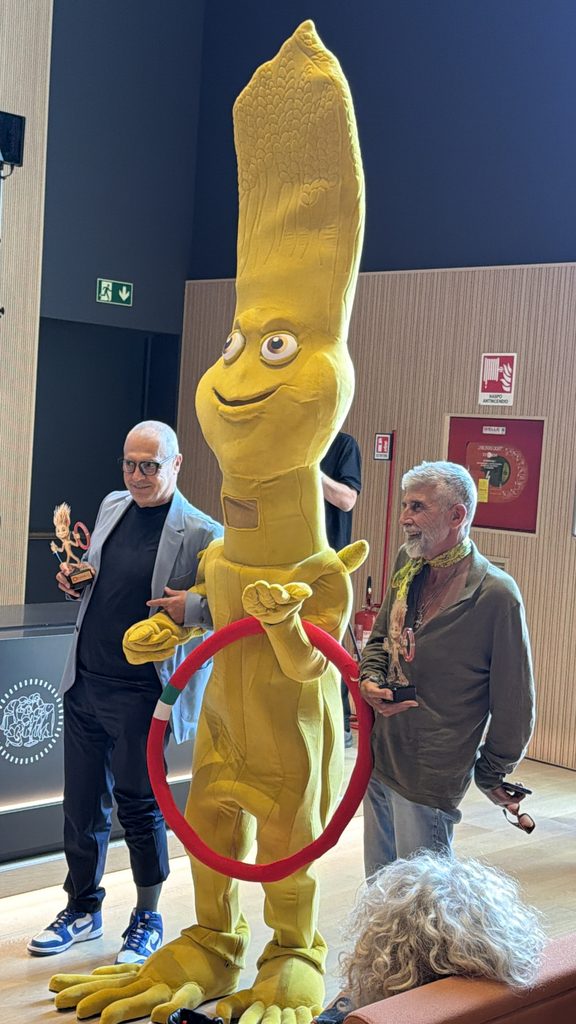
Meet SPIGO: Ocrim’s new mascot
The newest star of Ocrim Open Days 2026 and its ‘Wheat, Flour and … 2026’ conference was not a speaker but a mascot. Introduced by Stefano Mazzini, SPIGO was created to represent the spirit, values and future of flour milling: the journey of grain, the importance of sharing knowledge, and Ocrim’s commitment to connecting with future generations in an accessible, engaging and memorable way.
SPIGO is designed to travel, learn, meet people and visit mills, becoming a friendly face for an industry that often works behind the scenes yet feeds billions of people every day. Asked about his ambitions, he said he was looking forward to “meeting the next generation of millers and reminding everyone that innovation grows one grain at a time.”
The same celebration saw Ocrim’s owners, Alberto and Sergio Antolini, presented with commemorative awards recognising their leadership, vision and contribution to the global flour milling industry.