




























Milling journals of the past at The Mills Archive
by Mildred Cookson
In 1902 both the Miller (Fourth August) and Milling (Sixth September) featured articles on the Tring flour mills. At the time they were owned by Mr Willaim N Mead, nowadays they are owned by the Heygates family, milling more than 100,000 tonnes of wheat in a year. According to their website they mainly produce bakers’ flour, but there is also a major commitment to wholemeal for biscuits, bulk outlets, and a large output of 1.5 kilo bags from the prepacked flour plant – especially for the consumer market.
A historical overview
Mr Mead’s mills occupied a very commanding position and were typical of both old and new methods of milling. Besides the adjacent windmill, he also owned several other mills, one being a large tower mill, which had six pairs of millstones, at Wendover Buckinghamshire, on a site chosen for its proximity to the wharf of the recently opened Wendover arm of the Grand Junction Canal.
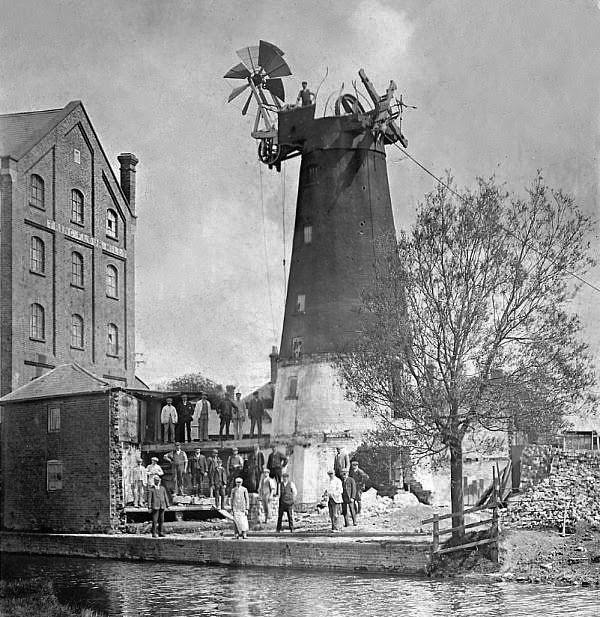
The original windmill on the Tring site was built for a Mr Grover around 1810. As the wharf was at the highest point of the canal, it was ideally situated. The tower mill was a five -storey mill with four double-shuttered sails. It was fitted out with three pairs of stones and was worked very successfully for the first 40 years by the Grover family. It appears around 1845 that the Grover’s were in partnership with Thomas Mead, relinquishing their interest as about 1850 they had another windmill, Goldfield Mill built some distance away.

Thomas Mead decided that the original windmill was not of sufficient capacity, and constructed the adjacent mill in 1875, fitted with an up-to-date model stone plant. Around 1891 the mills passed into the hands of William, the son of Thomas and a farmer and miller employing 20 men. The mills were situated in the centre of a good wheat growing district and from the top of the mill a grand view of the surrounding countryside for many miles could be seen.

Technological advancements
William decided to install a two and a half sack roller mill plant; and after exhaustive comparisons of various systems, Messrs ER and F Turner were chosen. As he found that the business was still increasing, and wishing to keep his mill up to date, he instructed Turners to increase capacity for four sacks an hour and to bring the mill up to date. The plant was actuated by a compound condensing beam engine, which only made 48 revolutions per minute and with a pressure of only 60 lbs of steam had no difficulty in running the whole mill, demonstrating the small amount of power required by Turner’s machinery.
The breaking of the wheat was done on two double sets of Turner rolls, each 30 ins by nine ins. Reduction was obtained through five double sets of smooth rolls each 15 ins by eight ins. There were four dustless purifiers, and ten centrifugals to the dressing, and an offal dividing machine. The flour was said to be very pure, and the yield satisfactory.
The centrifugals performed the dressing and an offal dividing machine practically completed the plant. The flour was of splendid quality and the yield very satisfactory. In all, the machines worked smoothly and quietly with apparent ease. The arrangement of the flow sheet had many departures from the normal. The governing feature of the mills diagram was to so arrange the connections that the machinery yielded as large a proportion of pure stock as could be obtained. Every purifier was treated with the utmost exactness and skill, with complete safeguards at every part, also there was no dust on the purifier floor. All machines were arranged in a simple and get at easy way with ample room everywhere.
Strategic location & efficiency
Situated on the Grand Junction Canal, the back of the mill was so close to the canal that barges could be unloaded direct into the mill, whilst at the front there was sufficient space for farmers’ carts to bring their wheat right up to the door.
At the time it was said that the milling trade in England must extensively grow, and this was one mill leading the way with the successful engineering of Messrs Turner and his representative, Mr HR Pertwee who had charge of the installation.

The Gamnel Wharf Mill, as it was known, is shown in Kelly’s directory to have had wind power available up to 1910, but in 1911 the windmill was dismantled for the expansion of the roller mill. At the outbreak of the war in 1939, the mill in common with all other flour mills, was brought under control by the Ministry of Food. This was to carry on for 15 years. In April 1941 William Mead died and the business came under the control of the Executors and Trustees. In 1944 the business was sold to Messrs Heygate and Sons of Bugbrooke Mills, Northampton, a family of farmers and millers going back 400 years.

In 1952, at the age of 81 Mr. William Bushell died after working as millwright at the Tring mill since he was eighteen. In 1954 there were 40 employees in various jobs, mill men, warehousemen, sack warehouse men and women carpenters etc., Many employees had been with the firm for over 40 years, at least two, William Drake and Albert Horn, since they left school. Albert Horn’s father was the last man to run the windmill.
Published in the November 2024 issue of Milling and Grain.