































by Starlina Rose, The Mills Archive Trust, UK
As the premier trade magazine for the milling and grain industry across North America, the Northwestern Miller covered the wide-ranging difficulties of the industry in the 1930s on an exhaustive week-by-week print schedule.
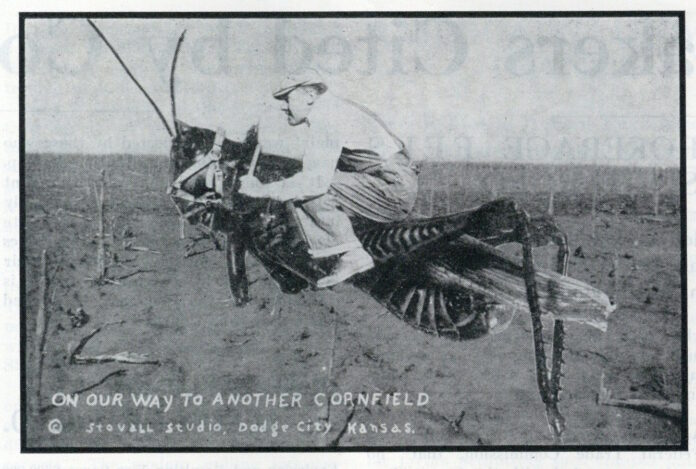
In addition to the droughts and the dust storms, wheat and cereal growers had to deal with clouds of grasshoppers alighting in fields, taking entire plantings of grain in a matter of hours, leaving behind stalks chewed to the ground, and barren soil. According to researchers, the dislocation and loss of topsoil across millions of acres was one of the contributing factors to this ‘grasshopper menace,’ along with government subsidies that paid farmers not to plant crops – which created a fertile breeding ground for the insects.
Unbeknownst to Roosevelt, the government and the subsidised farmers, this act would create an almost unmanageable pest situation that quite often did away entirely with the crops that were planted. In his September 1937 article, ‘G. Hopper Defies Regimentation,’ CC Isely sums the situation up:
“When the AAA boldly announced that agricultural production could be restricted like the output of an automobile factory, the ideal appealed to reason. Its administrators set aside 15% or 20% of the wheat acres of each beneficiary to be grown to Russian thistles or whatever the land willed to grow. These idle acres, not too hard nor yet too soft, covered with the protective weeds or prickly thistles, made a perfect nursery for a brood of grasshoppers.”
He goes on to say, the pests “Thrived and multiplied in 1933, 1934 and 1935 in these favoured ‘wild life’ preserves, in at the corner of every wheat field which received AAA benefits,” and like “a plague of Egypt, the grasshopper came singly and in droves,’ stripping ‘corn and alfalfa, trees and flowers.”
According to the Northwestern Miller, farmers worked to manage the pests by traversing the fields early in the year, looking for infestations and burning the fields, spreading poisoned bran or even molasses to kill the eggs before they could hatch. The US Department of Agriculture (USDA) assisted – as part of the federal relief programme offered to farmers – by purchasing a total of 1145 tons of bran to be poisoned as a result of farmers’ bids filed on 8 May 1934. These numbers, according to this report, were but a single day’s worth of bids.
The poor farmers, beset by economic doldrums following WWI, and economic disaster following the crash of Wall Street in 1929 lost their subsistence crops to grasshoppers, and regardless of subsidy payments, many did not have the means to feed their families much less purchase enough poisoned bran to protect their fields.