




























by Dr Anna-Maria Nunez Vega, Grain Technik Pvt. Ltd, India
Global crop production faces substantial annual losses due to insect infestations, with estimates by the FAO suggesting that approximately 40 percent of crops, valued at US$220 billion, are compromised annually. Grain storage facilities provide ideal environments for insects, exacerbating post-harvest losses. Additionally, climate change is significantly altering storage conditions, particularly in moderate climates, leading to warmer temperatures and increased humidity levels. These changing conditions reduce the effectiveness of traditional ambient aeration methods, which are highly dependent on weather patterns. Concurrently, the traditional use of chemical fumigants faces increased resistance from pests and regulatory limitations, underscoring the importance of exploring reliable and climate-independent alternative methods. This article examines the effectiveness and necessity of grain chillers as a sustainable, economic, and efficient method for preventing insect infestation in both tropical and moderate climates.
Grain infestation challenges and climate impact
Stored-grain insects significantly threaten global grain reserves, with species such as the khapra beetle (Trogoderma granarium) exemplifying these risks. Listed among the 100 most invasive species worldwide, the khapra beetle’s rapid population growth under favourable temperature conditions highlights a common challenge faced by storage operators globally. Optimal developmental temperatures for storage pests typically range between 20°C and 35°C, dramatically accelerating insect reproduction. For instance, khapra beetle larvae can complete their development within as few as 15 days at 35°C, whereas the same development takes approximately 220 days at 21°C (Athanassiou et al., 2019). While traditionally prevalent in tropical regions, such favourable conditions are increasingly encountered in moderate climates due to climate change. Recent experiences from central Europe illustrate the escalating difficulties in achieving safe grain storage temperatures below critical infestation thresholds through traditional aeration methods, particularly during warmer and wetter summers (Nunez Vega, 2023). This shift underscores the urgent need for storage solutions that reliably maintain safe grain temperatures independent of ambient conditions.

Limitations of traditional aeration methods
Traditional grain aeration methods utilise ambient air to cool grain, a cost-effective approach originally developed for moderate climates, where cooler temperatures historically prevailed during post-harvest periods. These methods have never been intended or optimised for tropical regions. Theoretical engineering calculations state that, at an airflow rate of 0.12 m3/min/MT, 120 hours below a specified temperature are required to cool a storage bin or silo to this temperature (Noyes et al., 1992). This means that to achieve safe storage temperatures below 15 °C, at least 120 hours of aeration with ambient conditions below 15 °C and relative humidity (RH) below 70 percent are required. To achieve somewhat safe storage temperatures, an ambient temperature of below 20 °C and RH below 70 percent must be present. However, historical climate data from central Europe demonstrate that these conditions frequently couldn’t been met in recent years, preventing the consistent achievement of safe storage temperatures (Graph 1 + 2). This highlights the increasing vulnerability of grain storage to variable climatic conditions, even within traditionally moderate climates. In tropical regions such as Southeast Asia, grain storage operators consistently report severe challenges with insect infestations despite conventional aeration practices, further underscoring the inherent limitations of relying solely on ambient aeration in warmer climates.

Advantages of grain chilling technology
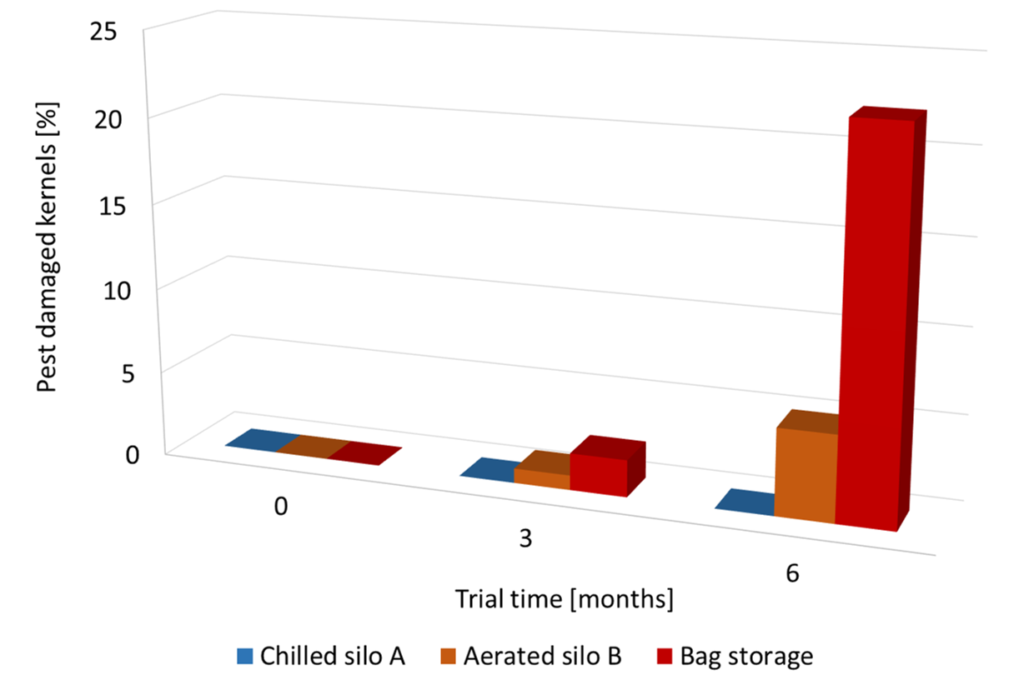
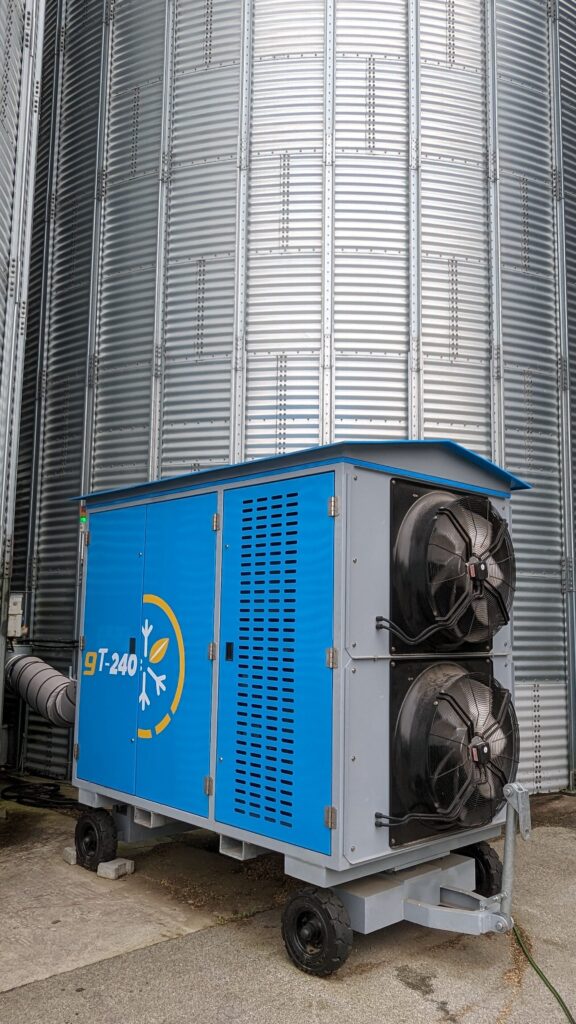
Grain chilling provides a reliable solution by artificially controlling storage conditions independent of external climate fluctuations. gT chillers rapidly reduce grain temperatures below critical insect developmental thresholds. A study conducted near New Delhi, India, demonstrated that grain chilling effectively prevented insect infestations over a six-month period. The chilled silo maintained grain temperatures around 16.8 °C compared to ambient-aerated silos at around 29 °C, resulting in negligible insect damage compared to significant infestations in traditional storage methods (Graph 3+4; Nunez Vega et al., 2024).
In moderate climates, grain chilling similarly provides reliable results. An initial chilling cycle immediately after harvest significantly reduces insect activity, usually eliminating the need for subsequent chilling even during extended storage periods. A gT chiller usually achieves target temperatures within approximately 7 to 10 days of continuous operation even in large-scale storage facilities, effectively bypassing uncertainties inherent in ambient aeration.

Economic considerations and sustainability
While initial investment costs for grain chillers exceed those for simple aeration systems, long-term operational costs and benefits significantly favour chilling technology. Grain chillers require minimal re-chilling cycles, enhancing their economic feasibility compared to recurrent aeration and fumigation cycles (Morales Quiros, 2017). Importantly, the operational running cost of grain chillers is typically lower than the combined cost of traditional aeration and periodic fumigation, making chilling a more economically sustainable choice over time. Moreover, grain chilling technology provides broader advantages beyond insect control, effectively preventing various qualitative and quantitative storage losses. By consistently maintaining low grain temperatures, chilling significantly reduces respiration losses, prevents mold and mycotoxin formation, minimises grain discoloration, reduces kernel cracks and breakage, and helps avoid silo corrosion, condensation, and blockage issues. Furthermore, grain chilling reduces dependency on chemical fumigants, minimising environmental impacts. Collectively, these advantages align strongly with the growing global demand for sustainable agricultural practices and enhanced food safety.

A critical component
Grain chilling emerges as a critical component in the modern strategy for grain preservation, significantly outperforming traditional aeration methods. By enabling rapid cooling and maintaining low temperatures, grain chillers effectively mitigate insect infestations, substantially reducing post-harvest losses. Given global climate changes and the resulting variability in ambient conditions, grain chilling presents a viable, sustainable, and economically justified solution. Its implementation across both tropical and moderate climates is essential for secure grain storage and overall food security.
Published in the April 2025 issue of Milling and Grain.