




























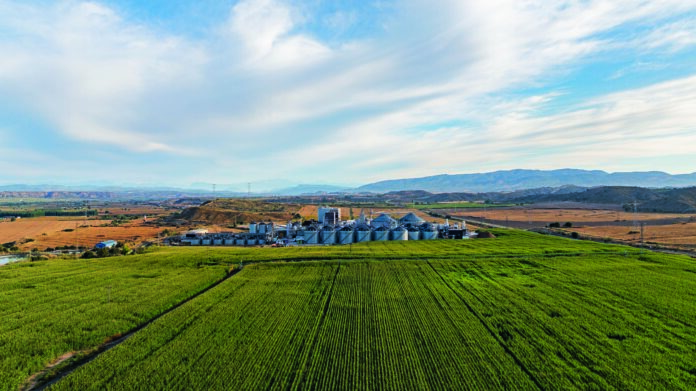
Quality Corn has commissioned Europe’s first hybrid maize mill combining pre-cooked maize flour for arepas and nixtamalized flour for tortillas in a single integrated facility. Developed in collaboration with Bühler, the five-story plant, completed in February 2025, can process up to 100,000 tonnes of maize annually and is designed to meet rising demand from Latin American cuisine across Europe.
When Agustín Mariné Trías, founder and CEO of Quality Corn, took over the family farm in Huesca province, Spain, in the mid-1990s, he was convinced that the local maize crop was being undervalued in its traditional uses as cattle feed and fodder. Time proved Marine right as he first shifted into production of grains for the snack industry and then into milling maize to make flour, and semolina for beer brewers.
More recently, Marine identified pre-cooked maize flour and nixtamalized flour as growth segments and decided to invest in a plant capable of producing both products. “Latin American culture has become part of daily life in Spain, and eating habits are evolving,” says Agustín Mariné Trías, Founder and CEO of Quality Corn. “We saw sustained demand and decided to position ourselves early in this segment.”
A hybrid production concept
The project marked a first for both Quality Corn and Bühler. While Bühler had developed hybrid concepts at near-industrial scale in Switzerland, this installation represents the first full industrial application of this kind in Europe.
“This is a key plant for Bühler – our first hybrid project of this type in a real production environment,” says Nadeem Nashashibi, Area Sales Manager Milling at Bühler. “Quality Corn’s ambition to serve multiple emerging markets with one integrated solution aligned closely with our technology roadmap.”
At the core of the plant is Bühler’s Prime Masa technology, which achieves the nixtamalization effect using maize grits and steam rather than whole kernels soaked in water. The system is integrated with pre-cooked flour production in a single facility. The existing Quality Corn mill supplies grits and semolina as raw material for the new processes.
The 20,500-cubic-meter facility was completed in February 2025. At full capacity, Quality Corn targets annual production of 30,000 tonnes of pre-cooked and nixtamalized flour, 28,000 tonnes of semolina and 6000 tonnes of dry-milled maize flour. The company expects to reach peak output within two years.

Flexibility enabled by digitalisation
The plant was designed to allow production flexibility as market demand evolves. Both pre-cooked flour and nixtamalized flour require steam processing, but nixtamalization involves additional alkaline treatment. Integrating both processes demanded careful engineering to ensure operational efficiency without disrupting the existing mill.
“With both processes conceptualised separately, the challenge was to create a configuration that allowed the customer to switch between products efficiently,” says Carlos Olivares, Technical Senior Sales Advisor Maize at Bühler.
Central to this flexibility is Bühler’s Mercury MES (Manufacturing Execution System), which connects sensors and process controls across the plant. Operators can define and store recipes controlling parameters such as temperature, pressure, airflow and retention time.
“With Mercury MES, the plant can be operated by one person,” says Luis Miguel Vivas Martínez, Head Miller at Quality Corn. “It allows us to monitor product parameters in real time and optimise production according to demand. The system identifies critical issues immediately and supports efficient energy use.”
The plant is equipped entirely with Bühler technology, including flakers, steamers, sifters, de-stoners, Antares roller mills and a Sortex LumoVision optical sorter. The sorting system removes grains affected by mould and potential mycotoxins, supporting food safety compliance.

Resource efficiency integrated into process design
The hybrid configuration also reduces environmental impact. Compared to conventional nixtamalization processes, the steam-based Prime Masa technology enables water savings of 84 percent and reduces energy consumption by 52 percent.
Instead of gas-fired heating systems, Quality Corn uses biomass boilers fuelled by post-harvest maize residues, forestry by-products and recycled wood materials. The facility is also equipped with solar panels, positioning the company to increase energy self-sufficiency as battery storage becomes more economically viable. “Technology and sustainability can work together to use resources more carefully,” says Mariné.
Responding to shifting consumption patterns
Maize has traditionally played a limited role in Spain’s milling industry, where wheat dominates. However, demographic shifts and changing consumer preferences are reshaping demand. With Spain’s immigrant population growing from one million in 1995 to nearly nine million in 2024 – including 4.2 million people from South and Central America and the Caribbean – demand for maize-based products such as arepas and tortillas has expanded significantly. Latin American food products have moved from niche ethnic markets into mainstream retail and foodservice channels.
The hybrid mill positions Quality Corn to serve both domestic and broader European markets with locally produced pre-cooked and nixtamalized flours. For Bühler, the project provides a reference installation for hybrid maize processing concepts that combine flexibility, digitalisation and resource efficiency.
As European food markets diversify and sustainability requirements tighten, integrated processing solutions that reduce water and energy consumption while enabling product flexibility are expected to gain relevance.