



























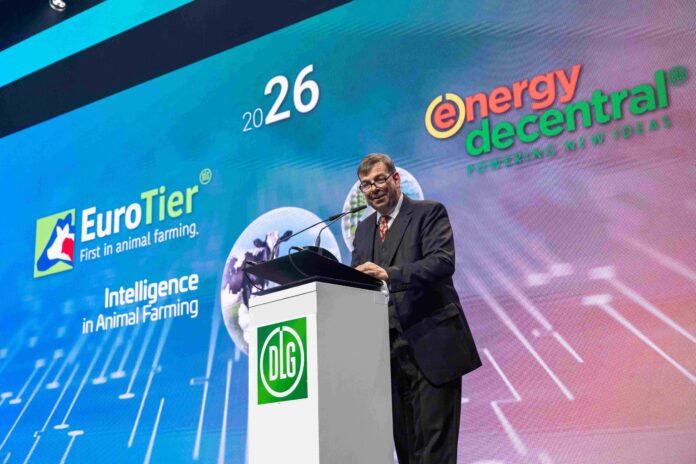
EuroTier 2026 has opened in Hanover with more than 2100 exhibitors from 55 countries, as the organiser highlighted diverging market conditions across pork, poultry and beef.
EuroTier 2026 and the co-located EnergyDecentral opened on Tuesday evening and run until 13 November, with two-thirds of exhibitors coming from outside Germany. The guiding theme is ‘Intelligence in Animal Farming.’
In his opening address, DLG President Hubertus Paetow said livestock farming can remain competitive in international markets only through sustainable productivity gains, requiring innovation, open export markets and strong entrepreneurial drive.
On market conditions, Paetow said competition for pork export markets has become particularly fierce following declining demand in China, the key importing market. He described the current situation for Germany’s pig sector as critical but expressed confidence that a competitive sector can be restored if government, authorities, processors and farmers work toward a common objective. Poultry, by contrast, is expected to see continued global growth as poultry meat remains a comparatively affordable protein source, which he described as a bright spot within livestock farming. In beef, production is increasing globally while EU supplies are becoming tighter.
Prof Dr Heinz Bernhardt, Chair of the EuroTier Innovation Award Commission, said the jury assessed 175 recognised innovations, awarding four Gold and 26 Silver Medals. He noted that digital animal monitoring, AI-supported analytics and automation are increasingly converging into integrated systems linking animal and operational data with housing and feeding technologies.
German Federal Minister of Agriculture Alois Rainer said farmers invest in technology not because it is “nice to have” but because they believe in their future, adding that no farm can permanently absorb higher costs for energy, fertiliser, labour and animal welfare if revenues do not keep pace.