
























The Julia Mill near Kecskemét is one of the largest grain mills in Hungary. Founded on green fields, modernisation is part of its DNA. The three managing directors would like to hand over the business to their successor in a few years. To this end, they are making the mill fit for the future. Julia is three years old when she breaks ground for the grain mill that will one day bear her name. Not in a sandbox, but in a field in the village of Kunszállás near the city of Kecskemét. Her father Johann Tiemens and his partner Attila Csontos bought the land, partly because the mayor promised them their own motorway access.
Today, twenty-one years later, we drive 100 kilometres south of Budapest along the country road to the Julia Mill, passing diggers and cranes. The motorway access is indeed being built, but it is not yet finished. The mill, on the other hand, has processed almost three million tonnes of grain since it began operation in October 2005.

Scale, strategy and automation
“If there is ever a time when we are not planning or modernising, I get restless,” says managing director Johann Tiemens during the mill tour. In 2005, the first wheat mill with a capacity of 220 tonnes per day started operation, followed in 2006 by a durum wheat line with 100 tonnes per day. Another wheat mill was added in 2008 with a capacity of 250 tonnes per day. With its daily capacity of 570 tonnes per day, the Julia Mill was for a long time the largest mill in Hungary and is now the third largest.
The mill site, with both soft and durum wheat profiles, has a high degree of automation and a laboratory equipped with a farinograph, extensograph and alveograph, as well as its own analytics. The company positions itself with a broad flour portfolio for the bread and food industry in Central Europe. Around a quarter of production is exported to other EU countries, three percent goes to non-EU countries and the rest remains in the domestic market.
Around 34 percent of customers are industrial companies, 20 percent are bakers and 22 percent are compound feed manufacturers. The reason for choosing the mill’s location is its strategically favourable position in the centre of the Hungarian plain, an important hub for transport and agriculture. “When the mayor said at the time that we would get the field including motorway access, it was like winning the lottery for us,” says managing director Attila Csontos. Even without motorway access, the choice of location has proved to be the right one.

Soft wheat and durum
“We focus on performance, and that starts with the raw material,” says Attila Csontos, who is responsible for raw material procurement. In the past, Hungary was famous for its wheat. He wants to build on that. “Hungarian wheat was particularly hard wheat with a high-water absorption,” explains Attila Csontos, who looks back on 34 years of industry experience, describing the advantages of the old varieties. In recent years, he has paid particular attention to the quality of the raw materials. Currently, he prefers five varieties – two from Austria and three from Slovakia.
“The three Slovakian varieties correspond to the old Hungarian varieties or have their good characteristics,” he explains. “Ukraine has 60 million hectares of the best soil quality and enormous potential. In contrast, Hungary produces only five million tonnes of wheat,” he explains his concept. Before purchasing the raw materials, his laboratory samples and tests every batch. Last year, around 400,000 tonnes of wheat. His employees visit every farmer and take samples, which they analyse in their own laboratory.

Quality assurance before quantity
The Julia Mill supplies durum wheat semolina for the pasta industry and fine flours. For soft wheat, its portfolio includes, among other things, pizza flour, coarse cake flour, bread flours and wholemeal flour. In addition, there are rye and spelt flours, both white and wholemeal. The type designations follow Hungarian standards and cover bread, biscuit, wafer and pasta lines.
Food safety is ensured by microbiological routines, pesticide and heavy metal testing, as well as DON control. Management is certified via the FSSC 22000 system, supplemented by a unified environmental permit and a halal certificate. The logistics are designed for bulk and bagged goods. An in-house fleet of silo vehicles with seven lorries and around ten drivers supplies major customers.
The packaging ranges from units of one to five kilograms for retail to 25-kilogram valve sacks and big bags on demand. For bran, the company uses woven polypropylene sacks. The machine equipment follows the principle of thorough pre-cleaning and stable process management. In the cleaning process, the mill also uses the Sortex colour sorter from Bühler. The automation controls the entire production process, so that one miller is sufficient per shift.
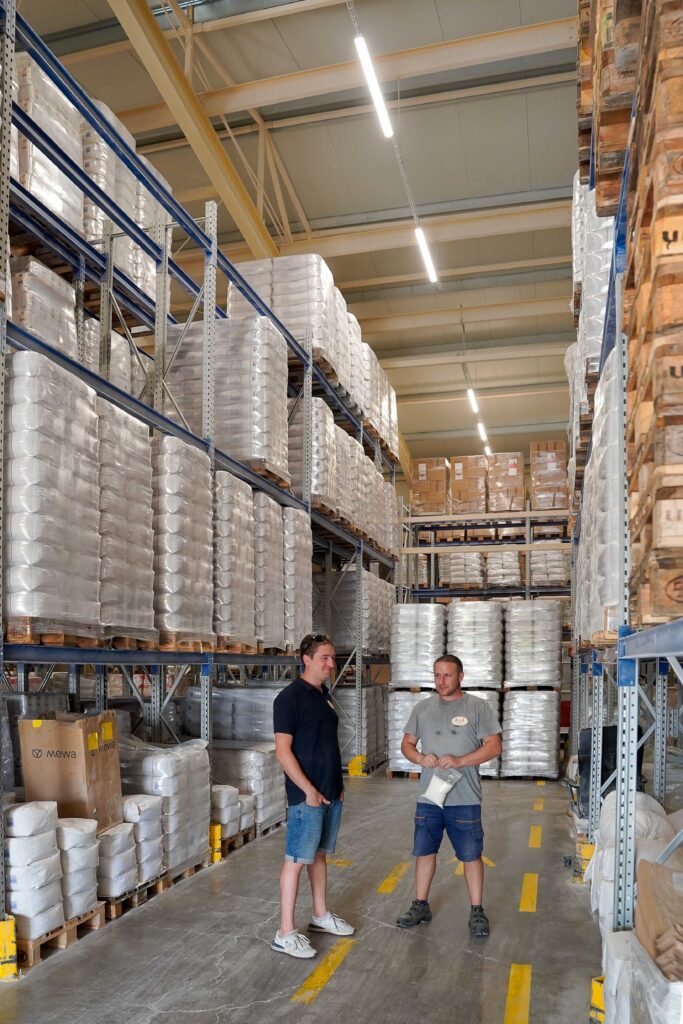
Johann Tiemens recalls the beginnings of production in 2005, when he produced only loose products from soft wheat and durum on the combined mill using GBS stands from Italy. The offices and the laboratory are still housed in containers and transport is via gravel paths. Success came quickly and since then, the revenue has been continuously invested in new technology. A total of 16 silos have been added one after another, each with a capacity of 2500 tonnes. In addition, there is a warehouse with bagging machines and a small packaging facility.

The technology partner
For the current modernisation and expansion, the company relies on the Swiss company Swisca. In the first step, the durum wheat mill is being converted into a combined mill for durum and soft wheat. For this, the company is installing four Romil roller mills as well as a sifting section of the Sifto plansifter. In the second step, expected in March 2026, the old roller mills from mill one will be replaced by 14 additional Romil roller mills.
“Our solutions are also attractive from an energy perspective. The output increases from 220 tonnes to 300 tonnes per day, without the mill consuming more energy,” says Swisca project manager Stefan Schmitz. “We work here with seven plansifter sections, which are installed as single or double sections depending on the configuration. In addition, there are two Dampe-type grain dampeners. One has already been installed, a second will be added for mill one.”
For weighing and dosing technology, the company supplies a Densi scale for measuring the moisture content of the wheat, as well as several Cervo-S bulk scales for the second mill and two finished product scales for the first line. Eight Floba-type dosing units have already been integrated into the wheat silo. The cleaning section is also being completely rebuilt. It is responsible for plant planning and coordinates the installation.
Colour sorters, trieurs and stone separators are purchased from third-party suppliers and supplemented with components from Swisca such as filters and screws. The company not only supplies the technology, but also provides project management, including support for the electrical installation, which is uncharted territory for the local electricians.
The commissioning is carried out by Stefan Schmitz and members of his technology team. “Two years ago, I was still alone; today, there are five technologists in the team,” he explains. With this expansion, the Julia Mill is setting new standards. In addition, the construction of a solar park and two wind turbines is intended to improve the mill’s carbon footprint.
Cooperation for animal feed
Technical director Ádám Csontos, who will take over the management of the mill in the future, is proud of the investment in a plant for the production of bran pellets. The plant is being built in cooperation with the company Vitafort, a leading feed company that covers more than a quarter of Hungary’s demand.
The American corporation Archer Daniels Midland (ADM) holds 30 percent of the shares in the company. Vitafort supplies the ingredients to produce high-quality feed pellets from the bran of the Julia Mill. The plant for the pellets is supplied by the German machine manufacturer Amandus Kahl, and production is currently starting up.