
























by Dr. Thomas E. Weber, PhD, Director, Nutrition Solutions, Kent® Nutrition
Soybean meal has long been considered one of the foundational protein sources in non-ruminant nutrition. For swine and poultry producers in particular, it remains a foundational ingredient due to its favourable amino acid profile, consistent availability, and compatibility with modern formulation systems and feeding programs. However, the way we think about soybean meal today is evolving.
Over the past decade, several forces, economic, nutritional and technological, have reshaped how feed manufacturers approach soybean meal utilisation. In North America especially, the expansion of renewable diesel and sustainable aviation fuel production has significantly increased demand for soybean oil.
Because soybean meal is a co-product of oil extraction, increased crush capacity has led to greater soybean meal availability. As a result, soybean meal is currently competitively priced and abundant in the marketplace and expected to remain so.
That dynamic creates opportunity, but it also means we need to be more intentional about how we use soybean meal. Greater availability does not automatically translate into better performance or improved efficiency. Extracting maximum value from soybean meal requires a deeper understanding of nutrient variability, anti-nutritional factors and the interaction between protein, more specifically amnio acids and energy in non-ruminant diets.
Managing nutrient variability
Soybean meal is widely recognised as an excellent source of crude protein and essential amino acids, particularly lysine. However, crude protein alone is no longer an adequate metric for evaluating value. Modern feed formulation systems are increasingly focused on digestible amino acids and the amino acid-to-energy ratio.
Soybean variation in crude protein and amino acid content, whether due to growing region, processing conditions, or genetics, can meaningfully influence formulation precision. Even relatively small differences in lysine and other amino acid concentrations can impact animal growth performance and feed conversion if not properly accounted for.
To manage this variability, many feed manufacturers are leveraging rapid analytical technologies such as near-infrared spectroscopy (NIR) to better characterise incoming soybean meal. When nutrient values are updated in real time and incorporated into formulation models, diets can be optimised more precisely, improving both cost control and performance predictability.
Equally important is a growing recognition that soybean meal contributes more than just protein. Emerging research suggests that the net energy value of soybean meal may be greater than previously published reference values, such as those historically outlined by the National Research Council (NRC). Underestimating its caloric contribution can lead to conservative energy assignments, potentially limiting performance and economic return.
Anti-nutritional factors: managed, not feared
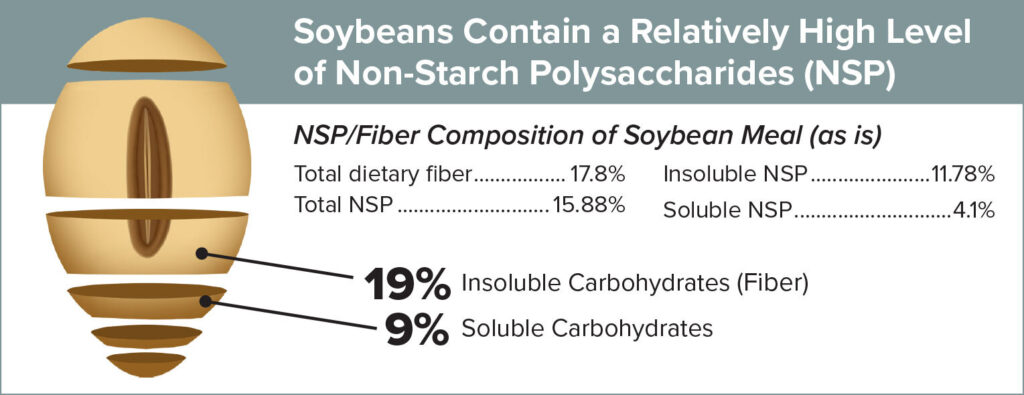
Soybean meal does contain anti-nutritional factors (ANFs), including trypsin inhibitors, phytic acid, and certain non-starch polysaccharides (NSPs). In younger animals such as newly weaned pigs or starter-phase poultry, these components can influence nutrient digestibility and gut function if not properly managed.
The industry today has a far better understanding of these factors than it did years ago. Trypsin inhibitors are largely controlled through appropriate heat processing during soybean crushing. Phytic acid is routinely addressed through phytase enzyme inclusion, improving phosphorus bioavailability and reducing environmental excretion. NSP-related challenges can be mitigated through targeted enzyme application or other feed technologies.
Rather than viewing ANFs as a reason to limit soybean meal inclusion, the more productive mindset is to manage them strategically. Understanding upper inclusion thresholds in young animals and recognising when higher inclusion rates are appropriate in grow-finish phases allows nutritionists to balance performance, health outcomes and cost.
Strategic inclusion and functional benefits
An area of increasing interest is the functional role of soybean meal beyond its nutrient contribution. In swine, research has demonstrated that higher soybean meal inclusion rates under certain conditions, such as heat stress or health challenges, may support improved feed intake, gain and feed efficiency compared to some alternative protein strategies.
Grow-finish pigs, for example, often respond favorably to elevated soybean meal inclusion compared to very young pigs, which may be more sensitive to residual ANFs. In broiler production, similar stage-specific responses can be observed, with mid-to-late growth phases offering greater flexibility for higher soybean meal use.
What we’re seeing in the field is that soybean meal inclusion should not be static across all phases. Strategic adjustments based on production stage, animal health status and environmental conditions can unlock incremental efficiency gains.
Protein and energy conversation
Feed efficiency in non-ruminants is fundamentally tied to the balance between digestible amino acids and available energy. Protein deposition requires energy. Therefore, optimising feed conversion demands an accurate understanding of both amino acid supply and caloric density.
Formulation systems commonly use amino acid-to-energy ratios as guiding benchmarks. If soybean meal energy is undervalued, diets may be inadvertently over- or under-fortified with supplemental fats or alternative ingredients.
Conversely, precise characterisation of digestible amino acids allows for more accurate reductions in crude protein while maintaining performance, which is an increasingly important strategy for managing barn ammonia levels and supporting gut health. Efficiency is not improved by amino acid balance alone. It is improved when digestibility, energy utilisation and amino acid balance are aligned.
From research to reality
Research continues to refine our understanding of soybean meal’s digestibility, net energy contribution, and functional properties. However, a consistent industry challenge is translating controlled university findings into large-scale commercial production systems.
Validating new inclusion strategies or novel feed technologies under real-world conditions, where ingredient variability, milling performance and health pressures intersect is essential. Cross-functional collaboration among nutrition, procurement and feed manufacturing teams plays a critical role in this process.
Modern data tools are accelerating this transition. Rapid ingredient testing, improved formulation software, and on-farm performance analytics enable faster feedback loops between theory and practice. When nutrient variability is tracked and performance metrics such as feed conversion ratio (FCR), average daily gain (ADG), and mortality are monitored in parallel, decision-making becomes more evidence-based and less assumption-driven.
Avoiding oversimplification
One area where the industry can improve is resisting the oversimplification of soybean meal as ‘just a protein source.’ Focusing exclusively on crude protein misses several important considerations such as digestible amino acid content and variability, net energy contribution, functional responses under stress conditions, and interactions with enzyme and probiotic technologies.
In some cases, soybean meal’s caloric value may be underestimated, potentially leaving performance gains unrealised. In others, cautious inclusion in younger animals may be warranted, while higher inclusion in later phases could enhance resilience and efficiency.
Preparing for the future
Looking ahead, expanded soybean crush capacity tied to renewable fuel demand is likely to sustain strong soybean meal availability. That supply dynamic creates opportunity for feed manufacturers to reevaluate optimal inclusion rates, particularly as more data emerge on energy value and functional responses. To prepare for future pressures, whether economic, sustainability-driven, or performance-related, feed manufacturers should:
- Invest in routine ingredient characterisation to manage nutrient variability.
- Formulate using digestible amino acids and accurate net energy assignments.
- Evaluate phase-specific and stress-specific soybean meal strategies.
- Integrate supportive technologies that enhance nutrient utilization.
- Validate research findings under commercial-scale conditions.
At Kent Nutrition, we have taken this approach by evaluating probiotic-based strategies alongside traditional enzyme systems to enhance soybean meal nutrient availability. The goal is not to replace soybean meal, but to unlock more consistent value from it under commercial conditions.
Sustainability goals also align well with improved soybean meal utilisation. When amino acids and energy are more precisely matched to animal requirements, nitrogen excretion is reduced, feed conversion improves and overall resource efficiency increases.
A needed mindset shift
If there is one mindset shift the industry should embrace, it is this: soybean meal is not a static ingredient. It is a dynamic nutritional tool. Its value extends beyond crude protein. It offers essential amino acids, meaningful energy contribution and under certain circumstances, functional benefits that support resilience and efficiency.
Anti-nutritional factors are manageable with modern processing and feed technologies. Variability can be addressed with improved analytics and formulation precision. Doing soybean meal right in a modern feed manufacturing operation means understanding its full nutrient and functional profile, managing its variability proactively, and deploying it strategically across production phases.
From our perspective at Kent Nutrition, the focus is on translating research insights into practical feeding strategies that work in commercial production environments. That means validating ingredient value, managing variability, and continuously evaluating how soybean meal can be used more strategically across growth phases. Soybean meal remains one of the most reliable and versatile ingredients in non-ruminant nutrition. The opportunity before us is not simply to use it, but to use it better.