



























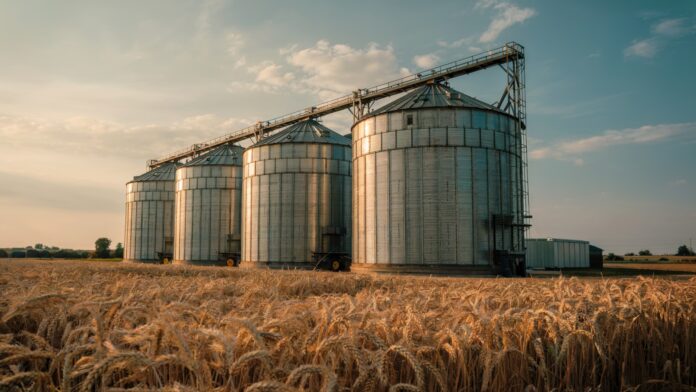
Egypt’s modern wheat silo capacity has more than tripled since 2014, growing from 1.2 million tonnes to 3.9 million tonnes, with the state targeting 6 million tonnes by 2030, according to the Egyptian Holding Company for Silos and Storage.
Private contractors including Hassan Allam, Orascom Construction and Samcrete are taking a share of the construction work, while lenders including the World Bank are covering part of the cost, as reported by EnterpriseAM. Egypt wheat storage expansion comes after repeated supply shocks since 2022, with the country seeking to hold more of its wheat at home rather than relying solely on global markets.
Ashraf Sadek, Managing Director and CEO of the holding company, stated that current silo capacity gives the state flexibility to hold reserves covering more than eight months of total wheat consumption. According to the USDA’s forecast of about 20.7 million tonnes of consumption in 2026/27, 3.9 million tonnes of silo capacity covers a little over two months.
Reducing losses through modern storage
According to Sadek, grain stored in open-air yards known as shona has cost the state 10–15 percent of the harvest, while losses in modern silos are close to zero. The World Bank estimates the reduction in losses at 40–50 percent compared to traditional storage.
Egypt has 69 state-owned silos, 50 of which belong to the holding company. The network supplies mills with approximately 24,200 tonnes of wheat per day, with sensors tracking stock. With the World Bank and other donors, the country is upgrading its information system to link silos, mills and bakeries.
Investment and expansion
The holding company aims to add 1 million tonnes of capacity in FY 2026/27, with Sadek telling Al Borsa in August that the company is investing around EG£7.5 billion to add 875,000 tonnes of grain storage capacity. Its own 44 silos held 2.56 million tonnes as of May, averaging about 58,000 tonnes each. Another 50 silos with a combined capacity of 1.5 million tonnes are under construction under the National Silos Project.
The World Bank is financing 700,000 tonnes of new and upgraded silo capacity, according to its 2025 report, while France’s AFD and the EU are backing another 375,000 tonnes. The European Investment Bank has approved an EU€90 million concessional loan for the Egypt food resilience project, with the EU contributing EU€100 million and the World Bank providing an EU€110 million soft loan.
According to the Supply Ministry, Feerum Misr — a Samcrete venture bringing technology from Poland’s Feerum — plans to make 80 percent of silo components locally within three years. It has committed to supplying parts for 1.4 million tonnes of capacity at fixed prices in local currency.