
























by Andrew Wilkinson, Milling & Grain
As we wave farewell to 2020, a year that has in so many ways been unprecedented, our thoughts naturally turn to what's in store for the industry in 2021 and beyond.
In an effort to find out, Triott is currently running a project called 'Milling 2030' that involves talking to customers, farmers and other industry figures in order to discover what would add the most value for them in future.
They then brought together their sister Triott companies within the group to brainstorm how they could achieve these ideals.
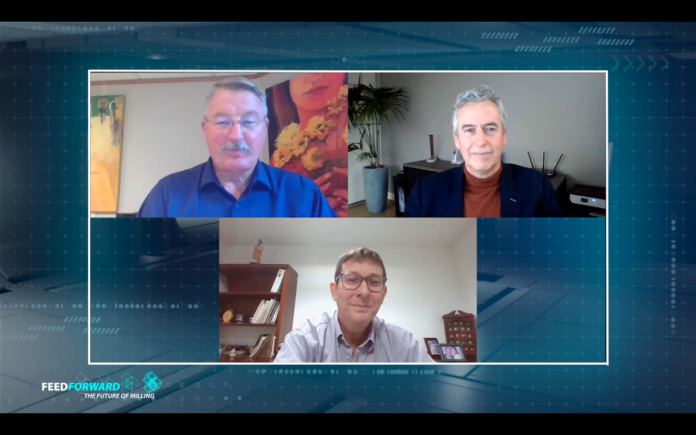
The aim of the company's most recent digital episode of 'Feed Forward', is to give us an idea of what a digital and data-driven future could look like, as well as what it could actually mean on a practical level. This webinar also tries to answer the question of how we will all benefit and how long will it take to achieve those benefits?
With the help of some quick fire insights from their feed milling customers and experts, the webinar's audience receives a glimpse into what the longer-term future could hold from Rene Ottevanger, Triott's new Director of Technology and Innovation.
While they do not claim to have all the answers, Triott states that they are committed to finding them by working together with everyone in the industry (including all of us) and defines this as their New Year's Resolution!
The current position
According to Rene Ottevanger, Triott is currently building turnkey feed mills for its customers, which means that they design and manufacture all of the machinery, deliver all of the electrics; including the control and automation.
However, Mr Ottevanger states that the company sees more value in the day-to-day processes of the feedmill, where they can help their customers. So they are helping feedmill customers to unlock more value from what they already have, as well as to get more value out of their machinery, their people and their total investment.
In this way, they are hoping companies will increase the quality of the product, increase their tonnages and of course, the overall profitability of their plants.
What does the feedmill of the future look like?
In principle the mill of the future will connect all of the elements of the plant at all levels, says Mr Ottevanger, a statement that extends to all mechanical, electrical and digital levels.
This comprehensive level of connection will then, in turn, allow them to look beyond the feedmill. From the field to the feedmill and then to the farm – all stages of the manufacturing process will be connected via The Cloud, adds Mr Ottevanger.
How can connecting at all of these levels actually benefit the feed mill owner?
Well the owner of the feedmill will be able to see what his plant is doing, so he can oversee the process, says Mr Ottevanger.
The operator will also have the ability to see, via their PC, tablet or phone, how much the plant is running, the quality of the feed being made and they can also see if their plant is running efficiently. They will be able to solve chokepoints and bottlenecks in their plant, for example. The operator is also able to see when the machinery is due for maintenance.
'That's what we call data-driven milling,' adds Mr Ottevanger.
A global perspective
General consensus during the webinar appears to support the view that more complexity and diversity in the feedmill will continue to present an increasing challenge that will require smart thinking to overcome. How do feedmills remain agile in order to address more complex processes?
The following are views from three continents on the subject of the future of feed milling to provide a more global perspective.
Wayne Cooper, USA – We do service first then we design mills to meet the customer's needs. We do not do cookie-cutter mills, we communicate with the customer to design a facility that is specific to his needs and what he needs to produce for his customers. We are currently looking at automation within the mill, with the goal of turning the plant into a giant robot in the future.
Mario Ocampo, South America – He is looking at using alternative materials in order to be more sustainable and animal friendly. If we are adaptable and flexible, when it comes we will still be there in the future. Be adaptable, be flexible – be nice!
Albert Getkate, Europe – Aiming to use a more complete process that can be specifically tailored to address market concepts as well as being flexible enough to produce tailor-made products. The latter can lead to lower efficiency and higher cost per tonnage. Operators should be looking to redesign and adjust the layout of their mills and select the most profitable setup.
Better decision making
With the 'Milling 2030' project, Triott is looking to the longer term.
The world's population is growing fast, so therefore the demand for protein is increasing. With the demand on feedmills set to continue and become more complex, by connecting everything in the mill Ottevanger says it can create a 'digital twin', a completely computerised simulation of the proposed plant.
How does that work? Well, in principle the process gets rid of all of the drawings, as currently all technical decisions are based on technological drawings. The company can then create a fully operational virtual feedmill, where they can simulate every single process.
What are the actual benefits of the mill owner?
The virtual simulation will allow the mill owners to make decisions based on the simulated process. For instance, he will be able to try out different setups, different formulations, different machinery and can test all of that within the physical and financial safety of a virtual environment. The main benefit being that he can make better decisions based on the simulation of the feedmill, without having to make a lot of additional investment.
Together Triott companies are working on refining the concept to maximise the value to their customer. In fact, they already have a cloud-based platform, where they collect and analyse data and this is already running successfully at a production location in The Netherlands.
In addition to this, the company is already working on start-up ideas to get more added value to the platform and to more or less prove that the concept is a workable solution.
According to Mr Ottevanger, the company is not claiming to have all of the answers, of course there are feedmills around the world that already use these kinds of processes.
However, Mr Ottevanger believes that value can be added to customers' existing setups with the addition of the company's support.
The difference Triott can make is that it can provide technology with a depth of knowledge of the feed milling industry. According to Mr Ottevanger, mill owners should be concentrating on the what and the why, leaving Triott to focus on the how.
Milling as a service
Following the examination of the value that the company would bring to existing digitised facilities, Mr Ottevanger continues by discussing milling as a service.
In the most basic of terms, this proposal involves the entire production facility being leased or outsourced to companies such as Triott, who will then take care of the entire production process.
In this arrangement, the customer actually pays per-tonne-of-feed produced. Mr Ottevanger then argues that milling as a service actually makes a lot of sense as other industries have done this for a long time. Manufacturers of photocopiers is one example of this, as customers are actually paying based on copies producted. Compressed air systems are also operated this way, based on the cubic compressed air used, he continues.
Mr Ottevanger then adds that if we really think about it, the milling industry started doing this centuries ago, when Triott began fixing windmills.
However, more obvious similarities exist between the proposed arrangement and how our ancestors brought bags of wheat to a local miller. The local miller would turn it into flour for a certain fee, so voila – milling as a service!
Mr Ottevanger believes that this will encourage millers to look to be more efficient, with the Triott companies more than happy to help them with this.
Small investment – higher profitability
The final element of the webinar sees a discussion between Triott's director of development, René Ottevanger, Marijn Laurensse (Inteqnion), Auke Markerink (Ottevanger) and Albert Getkate.
The general consensus between these assembled experts was that currently the market demands a very high range of flexibility and the need to prepare production teams for new technology.
In order to achieve this goal Triott believes that it has to provide its customers with the right tools to make the right feed in order to meet these predicted future demands. The panle added a word of caution however, by stating that, 'We have seen some great ideas today but we have to remember that some mills are only just beginning the digitisation process.'
In its basic format, a customer buys a 'workhorse' that he need to make a living from. Therefore, his goal is to increase productivity and uptime. This can be achieved by adopting proactive maintenance practices for example.
By implementing a prevention rather than a cure approach, which means 'fixing' the equipment when we want to rather than when we need to, will reduce down time from unexpected stoppages. This approach, although by no means a new one, will have a positive impact on profitability.
One factor that also has a major effect on profitability is the size of the workforce required to keep the plant operational.
Will the feed mill run itself in the future? The answer is yes but this won't be without a crew on site.
According to Triott, there will always be a need for skilled people in a mill – although in future they will require fewer operators on site. However, by using the data generated more effectively, the number of people needed to run a mill will reduce.
Going forward, Triott says it will be there to help its customers on this journey to a more data-drive and digital future and it looks forward to working with all customers in the future.
Salient advice
Albert Getkate then concludes the Webinar with some fairly salient advice for 2021, especially given how 2020 panned out, 'Plan, do, act and check. Always be flexible and always be prepared for the unexpected!'