



























The world’s top exporting nations score just 71 out of 100 for food system resilience, according to the inaugural Resilient Food Systems Index (RFSI) from Economist Impact, highlighting significant supply chain fragilities for millers and grain traders worldwide.
The index ranks 60 countries across four pillars – affordability, availability, quality and safety, and climate risk responsiveness – and finds that no country has a fully resilient food system. Portugal leads the index while the Democratic Republic of Congo ranks last, marking a 42-point gap between the most and least resilient systems.
The most concerning finding is the vulnerability of the world’s primary grain suppliers. The 15 largest food-exporting countries average a resilience score of just 71, while the 15 largest producers score 65.9—only slightly above the global average of 63.9.
“These countries play an outsized role in global food system resilience: when they function well, they stabilise markets globally; when they falter, the impact is felt around the world,” a press release from the Economist Impact states.

Infrastructure gaps threaten grain availability
The index identifies weak infrastructure as a critical bottleneck constraining food availability. Transportation and logistics systems scored an average of just 56.8, contributing directly to post-harvest losses.
Globally, 13.2% of food is lost before it reaches retail – grain that never makes it to millers. A further 19% is wasted at the household level.
“Many countries support agritech, but lack the basic infrastructure to scale it,” the release notes. Access to reliable electricity and internet remain “far below the universal levels needed to deliver system-wide impact.”
Affordability does not guarantee access
While food affordability scored highest overall with an average of 71.8, the index reveals persistent inequality in access to nutritious food. A 46-point gap exists between high-income (81.1) and low-income countries (34.9).
For millers producing staple foods, the finding carries a stark warning: in 62% of countries, the cheapest healthy diet absorbs nearly two-thirds of the poorest households’ income. Affordable grain does not automatically translate into accessible, nutritious food for vulnerable populations.
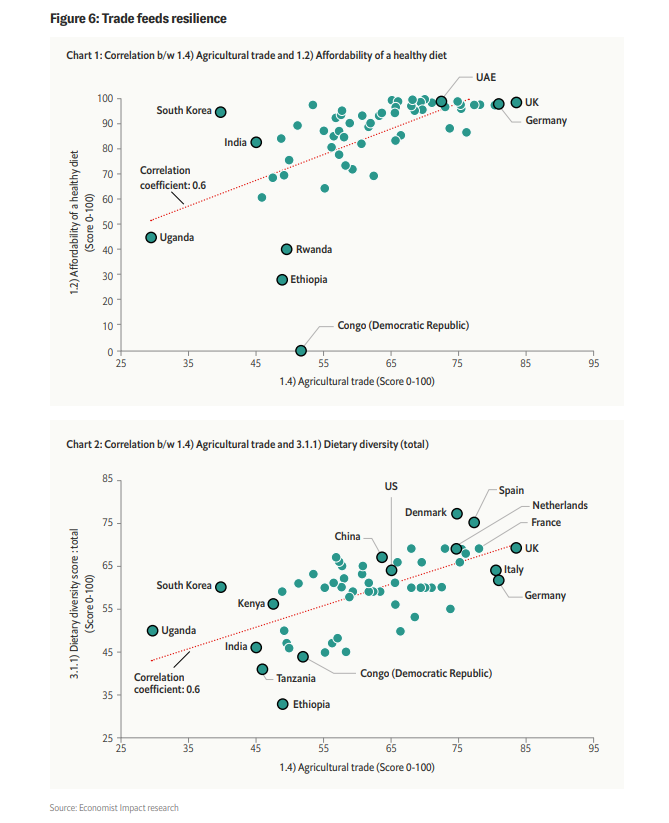
The index shows that agricultural trade correlates strongly with both affordability of a healthy diet (0.60) and dietary diversity (0.62), suggesting that open trade lowers costs and widens nutritional choice – a relevant finding amid current tariff disputes and trade policy uncertainty.
Climate resilience: the weakest link
Climate risk responsiveness is the weakest-performing pillar in the index with an average of 56.4, signalling a clear vulnerability for grain-producing regions facing more frequent weather extremes.
While research into low-emissions agriculture scored relatively high, agriculture-specific efforts to mitigate risk and adapt to changes averaged just 34. This gap suggests that research is not translating into widespread, measurable action at scale – a concern for millers relying on stable, predictable grain supplies.
Three strategies from the Resilient Food Systems Index
The index outlines priority areas for coordinated action:
- Advance affordability alongside access and nutrition by diversifying agricultural partnerships and expanding supply chains for nutrient-rich foods.
- Scale infrastructure and innovation through investment in transport networks, cold chain capacity, and equitable internet and mobile access to reduce food loss and expand market access.
- Strengthen climate resilience by translating innovation into agriculture-specific adaptation strategies and mobilising financing to implement proven solutions.
“The data show food systems are deeply interconnected: when countries implement targeted, coordinated action across key resilience levers, the benefits ripple across entire systems,” said Jonathan Birdwell, global head of policy and insights at Economist Impact. “But if these interventions fall short or happen in isolation, overall system resilience will deteriorate.”
Brian Sikes, Board Chair and CEO of Cargill, which supported the research, added: “Everyone needs dependable access to nutritious, affordable food. This research offers valuable insights that can help strengthen the world’s food systems.”
The Resilient Food Systems Index is part of The Food Imperative, a multi-year programme from Economist Impact exploring the future of global food systems through data, insight and policy engagement.