
























by Mildred Cookson, The Mills Archive, UK
I am continuing the survey of Eastern Scottish mills at the time of the 1902 National Convention in Edinburgh (see my article in the previous two issues of Milling & Grain), by focusing on two more that attracted attention at the time.
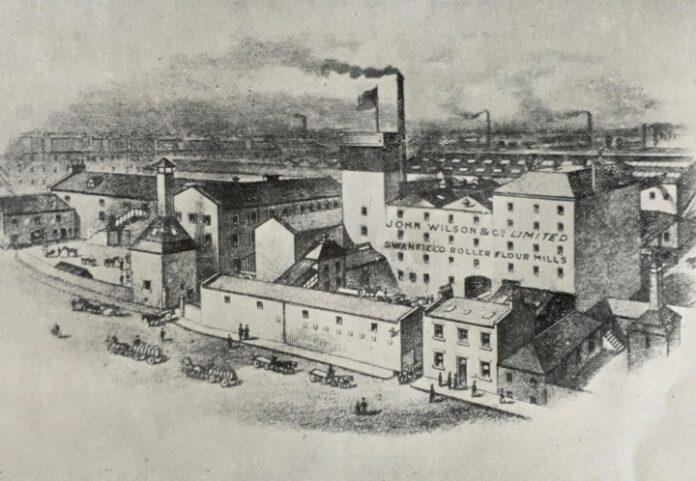
John Wilson & Co Ltd'sSwanfield Mills, Leith
John Wilson started in the milling business in 1890 after 23 years as a salesman for the Ted Brothers of Stockbridge Mills, Edinburgh. By 1902, his Swanfield Mills were vastly different from how they were when he bought them in 1890. He first installed a five-sack plant, but as trade developed, he employed Henry Simon to enlarge and improve the plant.
As well as flour milling Mr Wilson also manufactured pearl barley, special feeding meals and split peas. By 1902 the Swanfield Mills housed a new Simon 16-sack plant, an up to date provender plant with seven pairs of stones and a complete barley and pea mill.
The milling plant was placed in an oblong building none too large for the machinery it would contain. Two-line shafts, two Simon detachers, and the elevator bottoms occupied the basement. The roller floor above consisted of three lines of double Simon roller mills, from 32-to-40 inches in length. Sixteen pairs were for working on the breaks, and thirty on the reductions.
The second floor housed seven Simon dustless purifiers, with double expansion chambers and narrow sieves. Improvements were being added all the time: one employed eccentrics on the first motion shaft actuating the sieves, working continuously in oil and encased in tight-fitting boxes. The shake of a purifier sieve was important to make the middlings travel evenly over the sieve and the oil boxes ensured smoothly working and a perfect shake.
The dressing, scalping, grading and dusting machines were all on the third or top floor, comprising of 23 single three-sheet Simon centrifugals, two reels, three sieves, one quadruple 'Manchester' rotary and three double horizontal centrifugals.
The first two breaks were scaled on the rotary sieves and the last three on the double centrifugals, having been extracted by the preceding scalper. With the double centrifugals the bran part of the chop passed over a minimum of wire cloth, whereas in single cylinders the travel was much longer.
The cleaning of wheat involved 14 cockle and barley cylinders, a Cransons'sscourer, a Simon ventilated whizzer and a 'Victor' brush. The storage of grain and mill products was most adequate for a 16-sack mill. The warehouse was 160ft x 45ft, although it was planned to be replaced by a new one 90ft long x 45ft wide with three floors.
Three grades of flour were made, but the bulk was of the two higher qualities. The packing was partly done by American machines, but the power possers were preferred. Also, in the warehouse were flour and meal mixers, four being of Avery make, and two by Smith and Son of Leeds.
The miller who looked after the mill was Mr Williamson, quite a young man, having had his training as a miller in a leading Liverpool mill. The mill was well run with the able assistance of Mr. Wilson's three sons, William, James and John.
Scottish Co-operative Wholesale Society Chancelot Mills
The Chancelot Mills were owned by the Scottish Co-operative Wholesale Society. These organisations brought together groups of consumer cooperatives and were popular in districts which had factories and mines and, to a lesser extent, agriculture.
The Scottish CWS was more active than those in Lancashire, Yorkshire, Durham and Northern Ireland. Having only entered the flour milling business around the 1890s its ambition was demonstrated by the Chancelot Mills. Architecturally, as may be seen in the figures, they were one of the finest trade premises in the United Kingdom, and the machinery was just as impressive inside the mill.
The visitor on arrival at the mill walked through neatly shaped grass lawns and flower beds and was in no doubt he was approaching a distinguished flour mill. The wheat was brought to the mill by railway; the trucks used were hoppered for two points of exit and held ten tonnes each.
The Society owned 15 of them and had special rates from the ships at Leith Dock. The covered wheat house had 80 silos, each able to hold 300 quarters. Beneath these were 12 mixers.
The mill was fitted out with Henry Simon machines, dustless separators, magnetic separators, twelve cockle cylinders, and two scourers. The wheat was brushed by two 'Victor' brushes on its way to the first break after having passed through another magnetic separator and recording scales.
The mills had two excellent cleaning and conditioning plants, specially arranged for both hard and soft wheats. These were placed in the central building under the clock and tank tower.
The flouring plants were both in the left wing, one on each side, with the elevator lines down the centre. The winter wheat plant had a capacity of 12 sacks-per-hour and the spring wheat side 30 sacks.
The rolls for the hard wheat comprised of 26 double Simon 40-inch mills arranged in two lines. On the second floor were 12 double dustless purifiers. The floor above also had purifiers, as well as four scalping reels and four large 'Manchester' quadruple rotary sieves for first and second break scalping.
The top floor had 38centrifugals and five double horizontal ones, along with a rotary sieve stock scalper. The third and fourth break chops were treated on the double horizontal centrifugals that were said to work extremely well.
The winter wheat plant contained Simon rolls, five double sets on the breaks and nine on the reductions. The grading, dusting and dressing of the reduced stock was done on 19 centrifugals and two reels. This was all set out on four floors and quite separate from the spring wheat plant.
The warehouse was placed at the back of the premises with access to loading the railway trucks. There was a bake house for testing purposes and complete electric light plant with batteries and cells for storing enough current to light up for an hour in the case of an emergency.
Together with the Junction Mills (to be described next month), during 1901 the mills delivered 325,819 sacks together with 270,742 sacks of offals. Added to this oatmeal production of 550 sacks-per-week confirmed the successful nature of the business.
Please email me at mills@millsarchive.org if you would like to know more, or if you have any information, material or images that you would like to share.