






























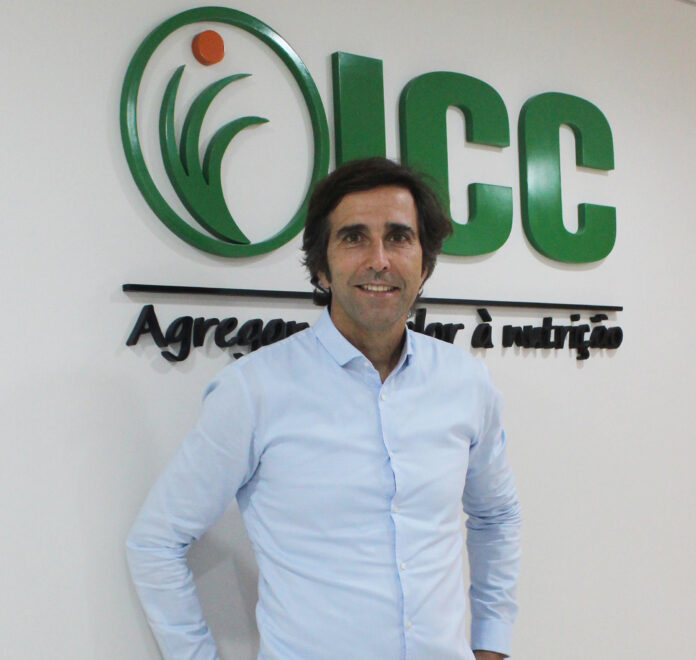
Glycon Santos was born and raised in São Paulo, Brazil. He has Bachelors degree in Engineering from Mackenzie University, and a Bachelors in Business from the University of São Paulo. Glycon founded ICC in 1992 growing it to become one of the world leaders in the production of yeast additives, with exports to more than 70 countries. His legacy is the transformation of the surplus yeast generated during the sugar cane ethanol fermentation which used to be discarded by ethanol mills, into a trustworthy and competitive source of yeast additive.
What are the unique and innovative natural solutions for animal nutrition ICC offers and why?
ICC is a Brazilian company, we celebrated 30 years last year, and we are specialised in the production of yeast additives coming from the sugar cane ethanol fermentation. We can claim that our legacy was to transform a waste product that was dried as a protein source, in feed additive recognized by its superior quality against other yeast sources, including brewer’s yeast and baker’s yeast. And what our company did is that we tried to understand the product, we try to benchmark it against the primary grown yeast or baker’s yeast, and also against the brewer’s yeast that were mainstream at that time, and we discovered that as our during the ethanol fermentation, the live yeast is challenged by very acid pH and high ethanol levels it grows a much thicker cell wall, which is highly concentrated in beta-glucans and MOS. The flip side is that the ethanol yeast will not concentrate so much protein, but that is ok, because it offers what the industry is looking for – the functional carbohydrates. So, beta-glucans are recognized to be very important for immune modulation, we have several trials showing how yeast beta-glucans can help on to modulate the immune system. In addition, beta glucans can also help to mitigate mycotoxin challenges, and MOS, when combined with the beta-glucans, act binding pathogens, such as E. coli or Salmonella, and building a much healthier intestinal tract.
For what main purposes you use yeast-based nutrition products for?
What we can say about our yeast is that this is not a one play product. If your concern is immune modulation, pathogen binding, mycotoxin mitigation, yeast is the way to go. And I want to be clear that yeast is not a silver bullet. Yeast can be used alone for sure and it will definitely bring reliable and consistent results. But ICC advocates that the yeast additives will have an even better performance when used in combination with essential oils, with acidifiers, etc. A joke that I always tell is that the problem with ICC yeast additives is that “our products do not kill anybody”. Our yeast additives carry pathogens out, our yeast additives modulate the immune system, they will not kill directly the pathogens but train the immune system to fight by itself. So, if you use ICC’s yeast additives in combination with essential oils, acidifiers, etc., there will be a strong synergistic effect, combining the best of both worlds. Because when acidifiers reduce the Ecoli and Salmonella challenge, it’s going to be much easier for the yeast additives to work. And vice versa.
So, this is really all about gut health?
Yes, it’s about gut health. And we know that when it comes to the immune system, 70 percent of the cells are in the gut. So, when we talk about the immunity, we are talking about gut health as well.
And is this widely understood outside Brazil? How are your international market development going?
Today ICC exports to 70 countries. Though several countries have a long tradition using yeast additives on their feeds, the yeast additives have been studied more and more during the last 30 years. There are several aspects of yeast that are connected to gut health, immune modulation, mycotoxin mitigation, and much more is to come.
Are many companies out there extracting the yeast from sugar, or is Brazil almost unique in this regard?
Brazil is almost unique in this regard, because also Brazil is the world’s largest producer of ethanol from sugarcane. We expect more countries coming into this arena. We also have the corn ethanol fermentation, that is huge in the United States and that is growing fast in Brazil and in other countries. The challenge with corn ethanol fermentation is that the corn is grinded in order to be fermented and in this case the yeast will come together with the DDGs. There are some companies that are extracting yeast with different industrial processes, but still, the cell count is not there. If you compare yeast derived from corn ethanol of United States, the cell count per gram is going to be at best 1/3 of sugar cane ethanol yeast, the brewer’s yeast, or baker’s yeast. So, the yeast produced from the corn ethanol is a very different product, more suitable to be used a nutrition source.