
























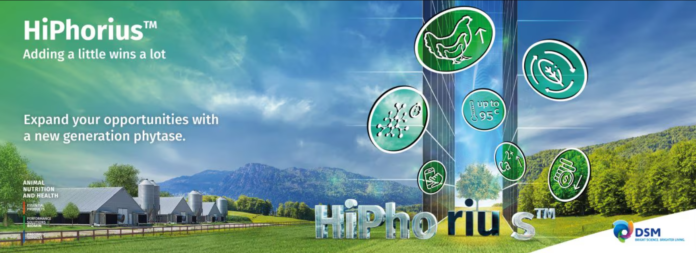
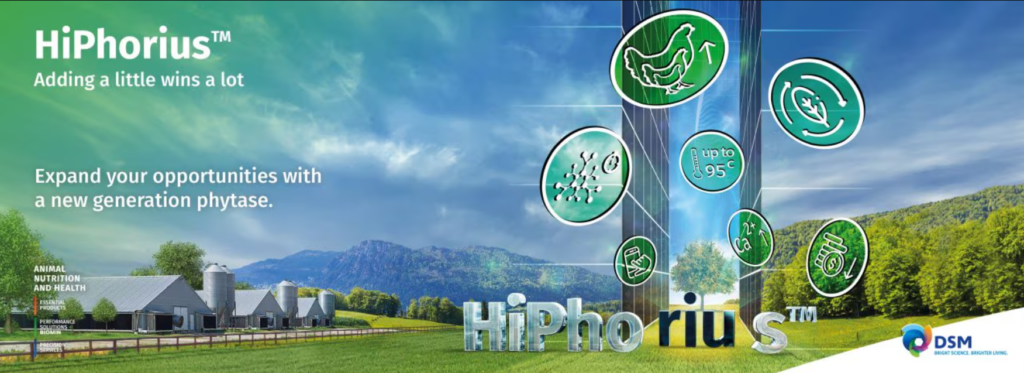
DSM-Firmenich announced the approval of HiPhorius™, their trademark phytase additive in the European Union. The approval stands for all poultry species for fattening or reared for laying or breeding, sows of all Suidae species and all fin fish in the European Union. HiPhorius™ is a new generation phytase which can help farmers achieve more sustainable and profitable animal protein production through more efficient phosphorous utilization and faster more efficient removal of the potent antinutrient phytate. It is a faster, more efficient phytase which opens the door to a world of phytate-free nutrition. By enabling animals to more effectively degrade phytate, the natural source of phosphorous in plant-based feed ingredients,
HiPhorius™ enhances phosphorous digestibility which not only reduces the need for costly inorganic phosphorus supplements but also enhances growth rates and feed conversion ratios. With this latest EU authorization, HiPhorius can offer significant benefits for poultry, swine, and aquaculture by improving animal performance, reducing cost of feed, and minimizing environmental impact. Sergio Schuler, Vice President to Europe, Middle East and Africa for Animal Nutrition & Health at dsm-firmenich said that the EU authorization marks a significant milestone for the feed industry and brings major benefits for producers across Europe.
The additive’s state-of-the-art formulation technology also ensures a range of superior product forms are available to guarantee enzyme activity is delivered to the animal in all feed production processes while unique user-friendly digital tools ensure simple and precise application. Adam Smith, Manager Marketing & Business Development Feed Optimization EMEA at dsm-firmenich says “The authorization in the EU for HiPhorius™ is a game changer for the European feed industry. I am extremely excited about the positive impact it will have on animal production efficiency and sustainability in the region. HiPhorius™ not only enables better phosphorus utilization with obvious benefits for livestock productivity and environmental footprint but by degrading phytate faster and more completely it paves the way to start implementing a range of nutritional concepts with potential to transform the way livestock are fed in the future.”