






























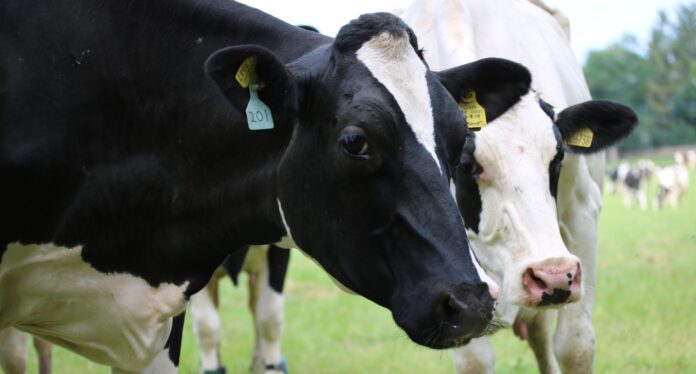
A GB£1.9 million UK-funded project is developing homegrown faba bean feed ingredients to replace imported soya bean meal and reduce methane emissions from dairy cattle. The InFaba Project, supported by the Department for Environment, Food & Rural Affairs’ (Defra) Farming Innovation Programme and delivered in partnership with Innovate UK, aims to cut greenhouse gas emissions while strengthening domestic feed supply chains for the UK dairy sector.
The three-year initiative is led by McArthur BDC and brings together a consortium including the Processors and Growers Research Organisation (PGRO), Scotland’s Rural College (SRUC), Muller UK & Ireland and Farm Carbon Toolkit. The project is developing two faba-based dairy feed products: a tannin-rich faba bean co-product designed to influence rumen fermentation and reduce methane production, and a heat-treated faba bean feed formulated to deliver highly digestible protein capable of replacing a substantial proportion of imported soya in UK dairy diets.

The consortium is targeting potential emissions reductions of more than 1.5 million tonnes of carbon dioxide equivalent annually, alongside improvements in farm profitability and feed security. Methane accounts for approximately 45 percent of greenhouse gas emissions from the UK dairy sector, while imported soya bean meal is associated with carbon-intensive supply chains and land-use change overseas.
The project will combine laboratory research with on-farm trials to assess methane output, feed conversion efficiency and milk production. Environmental life-cycle assessment and economic analysis will be used to evaluate the commercial viability and scalability of the new feed ingredients for widespread adoption across UK dairy systems.
John McArthur, Project Director and Managing Director of McArthur BDC, said the project brings together scientific rigour and commercial focus to deliver practical solutions for dairy farming. Professor John Newbold, dairy nutrition scientist at SRUC, said on-farm trials will generate robust data on methane reduction and feed efficiency under commercial conditions.
In addition to emissions reduction, the project is expected to support wider adoption of pulse crops within UK arable rotations, delivering benefits for soil health, water quality and biodiversity while improving domestic feed resilience. Muller UK & Ireland said the collaboration provides a direct route to test and scale the innovation across commercial dairy supply chains without compromising milk quality.