

























by Dr Frédéric Prothon, Technical Advisor AgriFood, Librixer, Sweden
The global push for healthier, more sustainable food systems has placed whole grain products (also referred to as wholemeal) at the forefront of consumer and regulatory priorities. Yet, despite their well-documented health benefits – such as reduced risks of type 2 diabetes and improved digestive health – whole grain products continue to face limited consumer acceptance. The primary barrier? Sensory and functional limitations in baking performance.
Traditional wheat flour milling produces sifted flours optimised for baking but strips away valuable nutrients, such as fibre, vitamins and minerals. Conversely, whole grain flours, while nutritionally superior, often result in denser textures, reduced loaf volume and shorter shelf-life making them less appealing to both bakers and consumers.
Whole grain consumption is rising worldwide, driven by health awareness, authenticity ideals and sustainability goals. However, many regions still fall short of recommended intakes. There are positive cultural examples where whole grains are already widely accepted, such as chapatti (atta), a traditional stoneground whole wheat flatbread in India, demonstrating how whole grains can be both nutritious and culturally beloved. This underscores the potential for whole grain products when processing methods respect both nutritional integrity and sensory appeal.
This dichotomy presents a significant challenge for the milling and baking industries: How can we deliver the nutritional benefits of whole grains without compromising on quality or consumer experience?
Traditional milling: A trade-off between nutritional quality and scalability
For decades, the flour milling industry has relied on two primary methods: roller mills and stone mills.
- Roller Mills: Dominate large-scale flour production, particularly for white flour. While highly scalable and efficient, they often prioritise yield over nutritional retention, with bran and germ frequently discarded or diverted to low-value applications like animal feed. The practice of reconstituting flours—blending endosperm, bran and germ into whole grain flours—is gradually being banned.
- Stone Mills: Valued for their ability to preserve the nutritional integrity of whole grains but their limited scalability and slower throughput make them impractical for industrial production.
Consequently, millers are facing two main choices to produce whole grain flours: either use current roller mill systems intensively enough to reduce the granulometry to an acceptable level, or use a stone mill, if available, with its inherently low capacity, leaving them with a difficult gap between quality and scalability.
Innovations in comminution: A path forward
Recent advancements in comminution technology—the process of reducing materials to smaller particles—offer promising solutions to the whole grain dilemma. Unlike conventional milling, which relies on mechanical shear and generates a high accumulated heat load, newer methods focus on more controlled but instant disruption of grain structures. This approach aims to:
- Preserve nutritional integrity by minimising damage to sensitive components like vitamins, proteins and fibre.
- Improve functional properties (e.g., water absorption, dough handling) to enhance baking performance.
- Increase scalability to meet industrial production demands.
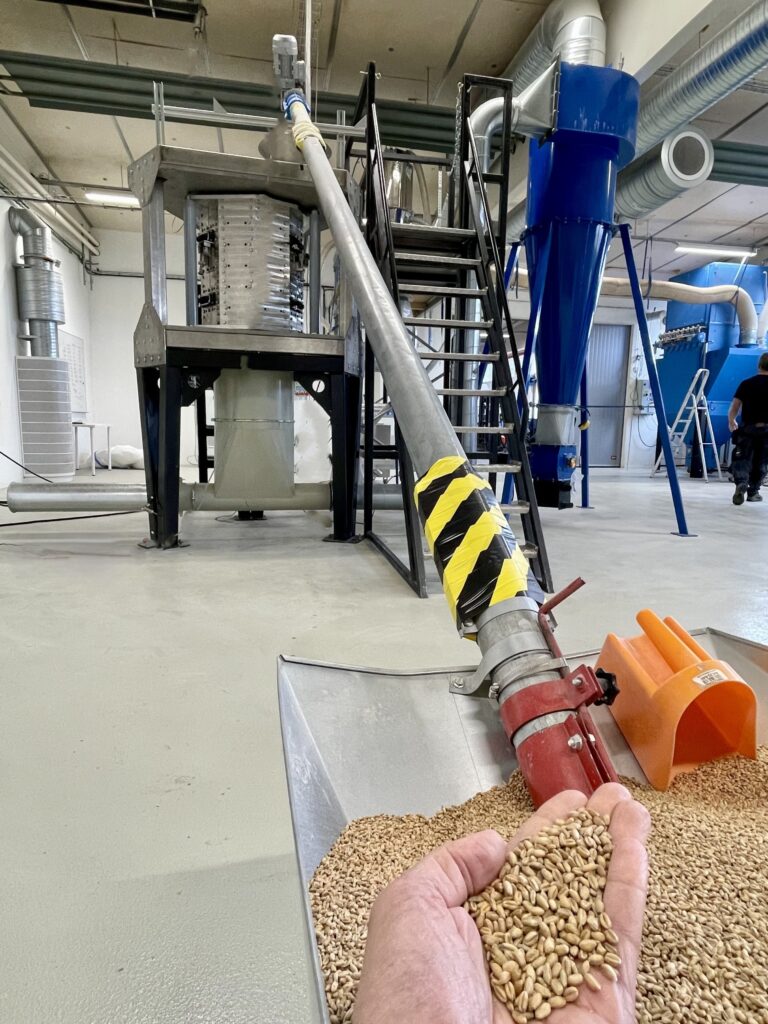
One such innovation is Librixer’s comminution technology, which has demonstrated the ability to micronise grain components along their natural boundaries using a dry, energy-efficient process in one single-stage. This method produces ultrafine whole grain flours with particle sizes significantly smaller than those achieved by traditional milling, leading to improved baking performance and sensory qualities.

Case study: Whole grain flour processing with Librixer technology
To evaluate the potential of this approach, trials were conducted on wheat, oats and rye using Librixer’s technology. The process involved:
- Dry, single-pass milling to produce ultrafine whole grain flours.
- Particle size analysis to compare Librixer-milled flours with so-called extrafine traditional whole grain flours.
- Baking tests to assess loaf volume, crumb structure, texture and sensory attributes.
- Nutritional analysis to measure fibre, mineral and moisture content.
Key findings
Reduced particle size
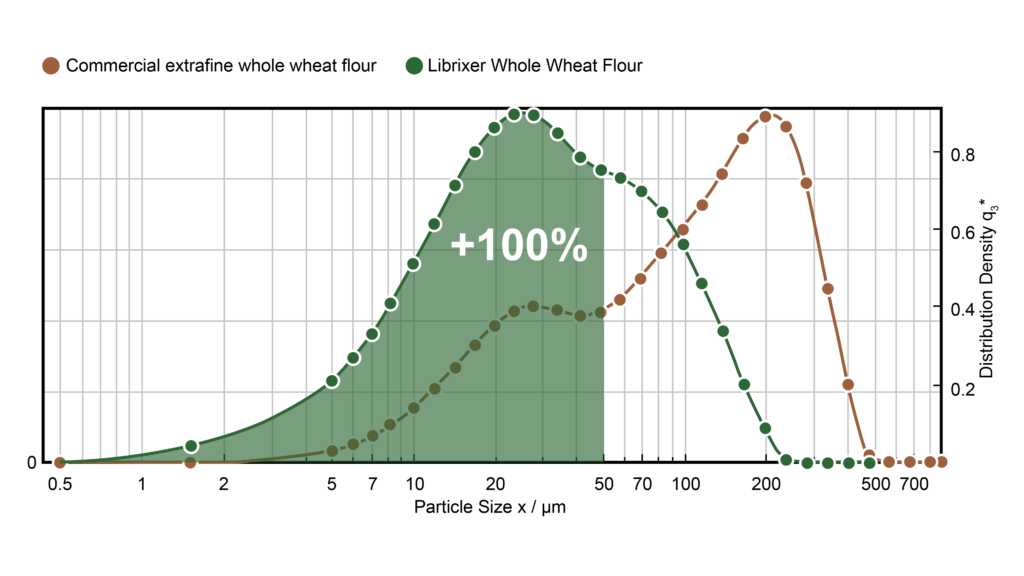
Librixer-milled flours exhibited a significant increase in fine particles (below 50 µm) compared to so-called extrafine traditional whole grain flours: Wheat showed a 100 percent increase, rye a 78 percent increase and oats a 60 percent increase. This finer particle size distribution contributes to improved dough handling and crumb structure, addressing one of the primary sensory challenges of whole grain baking.
Improved baking performance
Breads baked with 100 percent whole grain wheat flour (Librixer-milled) demonstrated comparable loaf volume and crumb softness to those made with refined flours. They also exhibited reduced coarseness and graininess, which are common complaints in whole grain products. Additionally, these flours showed enhanced water absorption and retention, with a reduced water activity that contributes to extended storage stability.
For rye and oat breads (60 percent whole grain, 40 percent sifted wheat flour), Librixer-milled flours showed higher gelatinisation temperatures and peaks, indicating improved starch functionality without increased starch damage. They also achieved better crumb cohesiveness and springiness, as confirmed by sensory analysis conducted at RISE Research Institutes of Sweden.
Nutritional and sustainability benefits
- Fibre and Mineral Retention: Librixer-milled flours retained up to 5× more fibre than refined flours and preserves essential minerals (e.g., magnesium, zinc).
- Waste Reduction: By maximising the use of grain components, Librixer’s process minimises waste, converting bran and other byproducts into high-value ingredients rather than low-value animal feed.
- Process Efficiency: The technology’s low footprint and modest energy consumption compared to traditional roller mills further enhances its sustainability credentials.
Processing as a double-edged sword
Processing inevitably alters the structural integrity of grain fibres. For example, mechanical breakdown during milling can increase the solubility of fibres like arabinoxylan and beta-glucans, potentially enhancing gut health. Technologies like Librixer’s, which focus on more controlled and instant disruption, aim to strike a balance—preserving nutritional components while improving functional properties for baking.
Industry implications: Toward a new standard for whole grain processing
The findings from these trials suggest that innovative comminution technologies like Librixer’s can play a pivotal role in addressing the longstanding challenges of whole grain processing. By improving baking performance, nutritional retention and storage stability, these methods offer a viable path for millers and bakers to meet consumer demand for healthier, more sustainable products without compromising on quality.
Opportunities for millers and bakers
- Diversification of product offerings: Millers can expand their portfolios to include high-quality whole grain flours that cater to health-conscious consumers and clean-label trends.
- Operational efficiency: The scalability and low footprint of technologies like Librixer’s make them suitable for integration into existing milling operations.
- Sustainability leadership: By adopting processes that minimise waste and energy use, the industry can align with global sustainability goals.
The future of whole grain processing
The milling and baking industries stand at a crossroads. With rising consumer demand for healthier, more sustainable foods and increasing scrutiny of ultra-processed products, the need for innovative, non-destructive processing methods has never been greater.
Overcoming Consumer Resistance
Despite the clear health and sustainability benefits, taste and texture remain the primary barriers to whole grain adoption. As noted by researchers, ‘Our taste buds adapt over time’—but only if products are available that meet consumer expectations. By improving baking performance and sensory qualities, technologies like Librixer’s may help bridge this gap, making whole grains a more appealing choice for both bakers and end-users.
As the industry continues to evolve, collaboration between millers, bakers, researchers and technology providers will be key to unlocking the full potential of whole grains. By embracing scalable, efficient and quality-focused solutions, the milling sector can not only meet the demands of today’s consumers but also shape the future of food.