






























by Vera Ferreri, Museum Manager, FlourWorld Museum, Germany
Puerto Cabello in Venezuela. Filling machines rattle and clatter in the Molinos Nacionales production plant. Workers fill fine wheat flour into sturdy sacks bearing the ‘Gran Aguante’ brand and portraying a muscular man in stark colour. He flexes his massive chest and pulls a heavy chain apart with brute strength. The image is reminiscent of old carnival and circus strongmen, as immortalised by Federico Fellini in his 1954 film La Strada. As a fifteen-year-old, Fellini was greatly impressed by such a circus strongman, who boasted to the crowd that he could break any chain simply by flexing his pecs.
On this South American flour sack the chain-breaker is not a performer, but a symbol. He suggests to customers that the strength in the grain is transferred directly to the body when products made with the flour are consumed. The flour promises strength with which you can truly break chains.
History books of milling
Flour is not particularly photogenic, but this odourless white powder leaves the mills of world to the tune of over 450 million tonnes per year. A bag made of jute, paper or plastic is enough to protect it from insects and moisture on its journey to the bakery. But the millers of the world aren’t content to print just the weight and company address on their product. They transform their flour sacks into a history book of many pages, for what appears on the sacks is more than just decoration. The images, words and brand names tell stories and archive traditions. They make promises, bear witness to history and carry cultural knowledge.
The artwork on the sacks shows what is in the flour – energy from the sun, vitality from the grain, status, tradition. Graphic artists approach this differently in every region. Where the West looks to tradition, the South talks of energy. Where Asia appeals to heaven, Latin America answers with faith.

Tradition as a promise
In Western countries tradition is the dominant symbolism. German sacks show historical windmills, rural harvest scenes or local landmarks like the ‘Roland’ in Bremen. Aurora, the goddess of morning, also appears, with the shining sun or precious diamonds. Such images bespeak artisanal quality, dependability and authenticity. They radiate a familiar stability. Those holding such a sack hold certainty and security.
The power of the sun
In other regions, mills take images from mythology and the animal world. In the background there is almost always the same force, the sun, that ripens the grain in the fields. In Senegal in West Africa mills use the lion for their flour sack art. The lion is the undisputed King of Beasts, and its majestic mane of yellow fur surrounds its head like a shining solar halo. The ancient Greeks and Romans honoured the lion as a symbol of the sun for just this reason. Those who buy the flour in this African sack buy the power of the sun, figuratively speaking.
In Indonesia mill workers fill flour into sacks bearing a heavenly motif – the Blue Dragon. This fabulous beast is considered a divine force in Asia. In Chinese astrology, the Blue Dragon marks the East and with it the direction of the rising sun. It stands for imperial power and embodies the endless energy cycle of nature, bringing everyday flour into association with the course of the stars.
Faith as a guarantor
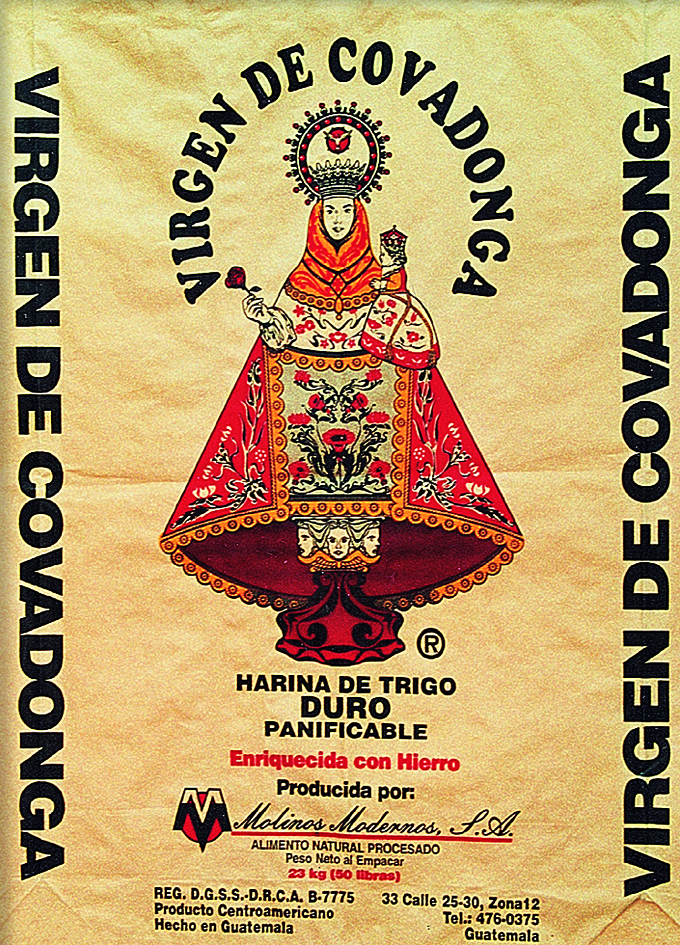
Religious figures are also used to vouch for flour quality. A sack from Guatemala bears a colourful image of Our Lady of Covadonga, a Catholic patron saint whom the Spanish conquistadors brought with them to Central America in the sixteenth century and who is renowned for her strong and pure faith. Strength and purity are central properties of high-quality wheat flour. In Christendom grain is considered an attribute of the Virgin Mary, who often appears in a dress of ears of grain in the pictorial tradition. In this culture, the religious imagery on the sacks is assurance of a flawless food, bringing faith and the product together.
In Mexico the Archangel Micheal appears on sacks and in Spain Saint Anthony is shown, while the Virgin Mary is portrayed on Greek sacks as the Madonna and child. Across religious denominations, mills seek association with the divine, for the divine stands for something no label can promise – trust.
High tech on a sack
Alongside these archaic and religious motifs, surprisingly modern artwork can be found on flour sacks across the world. In India, a country whose agricultural tradition goes back millennia, some mills have a made a conscious choice to use contemporary imagery. One Indian sack features a detailed drawing of a computer. It symbolizes the technological progress, high efficiency and modern machinery of mills, self-confidently portraying the ancient craft of milling as a high-tech industry. The computer demonstrates the flexibility of the language of the flour sack, which can show tradition, power, faith or progress, depending on the message the mill wants to send its customers.
An archive of symbolism
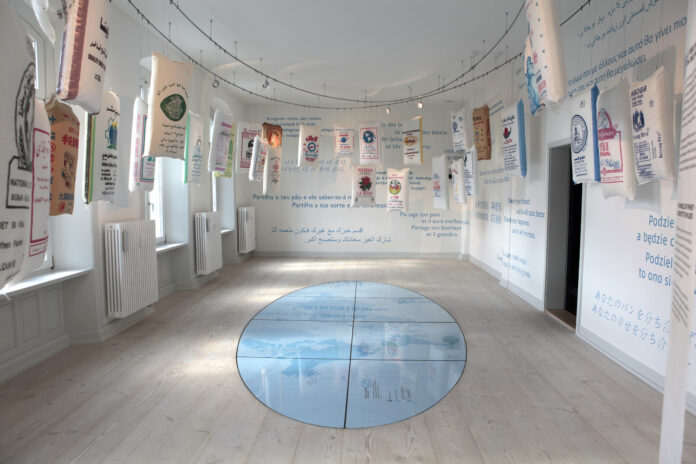
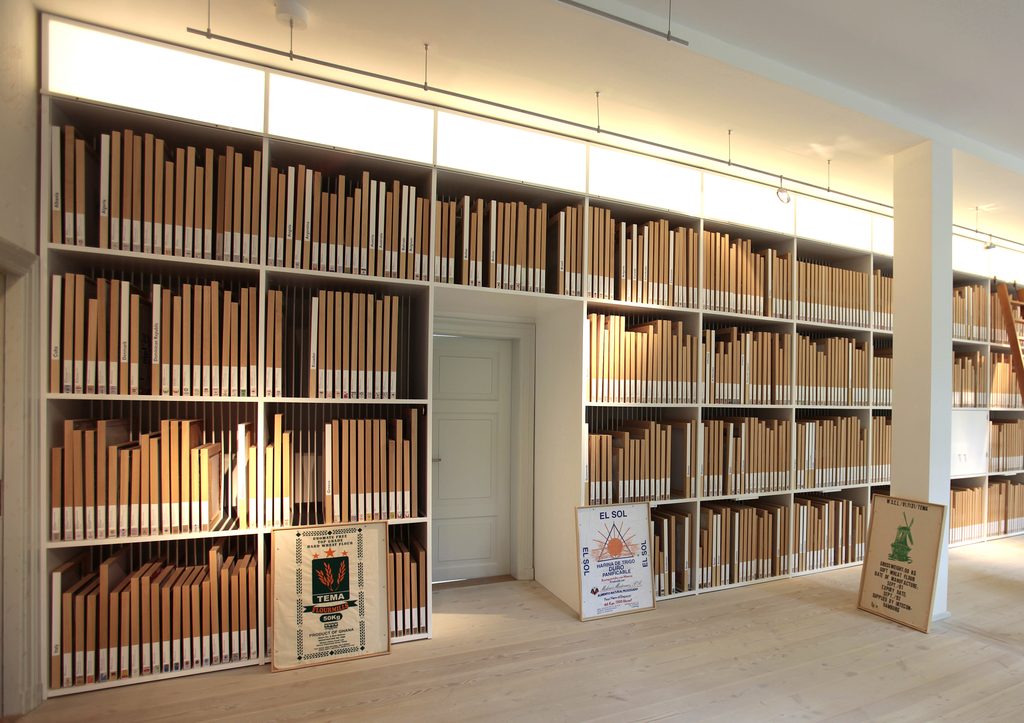
Over 4000 such artistically printed sacks from more than 1500 countries hang in the FlourWorld Museum in Wittenburg, Germany. In the bright rooms of this former district court, the sacks make up the Sackotheque, the only one of its kind in the world. The sacks hang side by side, arranged alphabetically by country. The collection is watched over by a special work of art by Berlin artist Kathinka Willinek, consisting of over ten thousand knots in differently coloured nylon threads that create a likeness of the ancient fertility goddess Demeter. In her hand she holds a double axe, whose semicircular edges symbolise the phases of the moon. The Earth and the heavens, the material and the tool, all come together in this tightly composed artwork.
A visit to the Sackotheque is a visit to a cultural archive. Every lion, every saint, every dragon, every computer stands for an answer to the same question: What’s in this powder, and what makes it good? And at the end of the exhibit, somewhere between Senegal and Sumatra, is the strongman of Puerto Cabello. He holds the ends of the broken chain in his hands, reminding us that a single sack contains over 25 kilos of flour. In this image is the promise that mills have kept to their customers for thousands of years – there is power in this powder.