






























by Joy Nelloolichalil, Milling and Grain
This feature is based on a visit by Milling and Grain to Tekpro in North Walsham, Norfolk, UK, where the team met with Sales Manager Tyrone Moy. The article covers the Holmen pellet durability testers, Insectomat and Samplex grain sampling systems demonstrated during the visit. All information is drawn from that on-site discussion and demonstration.
There are some moments during a factory visit that stay with you long after the machines have stopped running. For this time, it was not the size of the equipment or the technology inside it, but a single insect.
When we visited Tekpro in North Walsham, a town and civil parish in Norfolk, UK, Tyrone Moy, their Sales Manager, told us a story from when he first joined the company. He was testing the Insectomat, a machine designed to test insect infestation in grains. He ran a sample through the machine, and it identified a single insect. Curious, he put that same insect back into the sample and ran it through again. The machine separated it out a second time.
It was a simple test, but it captured what struck us most about Tekpro ‘s machines: their honesty. They do not interpret the sample or make assumptions about what should be there. They give you what is there. Run the test again and the machine should give you the same answer.
That idea of honesty in measurement became a thread running through our visit to Tekpro, from the Holmen pellet durability testers and Insectomat to its Samplex grain sampling systems.
That matters in an industry where decisions are made on the basis of what is measured. Pellet durability affects feed quality and production decisions; an insect in a grain consignment can have consequences for storage and export; and an unrepresentative grain sample can give a misleading picture of an entire load. In each case, the value of the machine lies in its ability to tell you the truth about the material in front of you.

The pellet durability testers
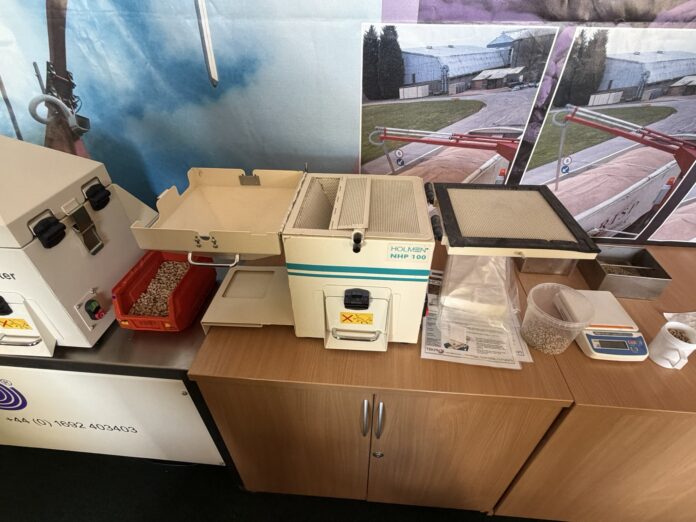
Our first introduction was to the Holmen series of pellet durability testers. Tyrone took us through three machines: the NHP 100, NHP 200 and NHP 300.
The Holmen NHP 100 is the oldest and most straightforward of the three. The sample is first weighed, with 100g recommended as this makes the subsequent calculations easier. The pellets are then placed into the machine, where they enter a perforated mesh hopper.
Air is blown upwards from the bottom of the machine, causing the pellets to move within the screen. As the pellets are agitated, broken pieces and fines are separated and collected at the bottom. Once the test is complete, the remaining pellets in the hopper are weighed. The result can then be used to calculate the Pellet Durability Index (PDI).
The NHP 200 builds on this process by incorporating sieving and weighing into the machine itself. A sample of between 80g and 120g can be added for testing. The product is first sieved and weighed before entering the conical screen, where the air flow separates the broken material from the intact pellets.
The NHP 200 also includes an integrated filter and a self-cleaning function. The broken particles are collected in a cup at the bottom of the machine. Both the NHP 100 and NHP 200 use a single-phase motor located at the rear of the machine.
The NHP 300 is the most advanced machine in the series and uses a three-phase motor. An 80-120g pellet sample is added through the inlet valve. Before the sample is introduced, the machine is purged.

The NHP 300 then carries out the dedusting process before conducting the test. Once the test is complete, the machine displays the PDI and average PDI on screen, together with a graph of the results. It can also be set to repeat the test, allowing an average to be calculated from multiple runs.
NHP 305 W software has been developed specifically for use with the machine. The software operates in ASCII format, which also allows it to work with third-party software systems.
For Tyrone, the purpose of pellet durability testing is not simply to achieve the highest possible number.
“There is no such thing as an ideal durability,” he explained. “You have to consider what’s right for the animal you are feeding, the cost of production and the customer. You have to find a sweet spot that benefits everyone.”
The point is important because pellet quality is not determined by one figure alone. A manufacturer has to balance durability with production costs and the requirements of the animal and customer.

Finding what should not be there
The next machine we saw was the Insectomat, which is widely used in flour mills and for cereals including oats, wheat and barley. It has also been used with corn by some of their customers.
The machine uses a vibrating mesh screen to separate insects from grain. Once the sample is introduced, the material passes over the screen and is separated into two collection trays, allowing insects and grain to be examined separately.
The purpose of the machine is straightforward, but the consequences of finding an insect can be significant.
Tyrone explained that, according to the Home-Grown Cereals Authority, one insect in 10kg can constitute an infestation under the relevant guidance. He also noted that Lithuania currently represents one of the strongest markets for the Insectomat. Grain destined for some markets must be certified as insect-free, while gas treatment may not be an option in some countries like as it is an expensive option.
Tyrone also shared an example from a mill in Essex, UK. The mill was importing grain at around UK£400 per tonne and used the Insectomat to check the material before bringing it into storage. They found the grains had insects in them. The machine stopped a bigger problem for them – if infested grain entered a storage facility, it could potentially contaminate the wider stored supply.
For the mill, identifying the problem before storage was therefore the easiest and most economical solution.
Getting to the truth of the load
Tekpro also showed us its Samplex grain sampling systems, which the company has manufactured in the UK continuously for more than 35 years.
The Samplex range uses a gravity-fed sampling system with variable aperture control, designed to obtain a representative sample from the full depth of a load. The truck probes use an electro-mechanical construction rather than high-pressure hydraulic hoses.
One of the differences Tyrone highlighted between Samplex and competing systems is the way the sample is collected.
While some competing machines use suction, Samplex uses positive airflow. When a truck arrives, the Unispear probe is lowered into the load, reaching towards the bottom of the truck. Grain enters the probe through gravity, before the positive airflow moves the sample through the system.
When the probe reaches the bottom of the truck, the sensors detect its position and the system adjusts accordingly. This allows the probe to reach the appropriate depth and collect the sample.
The objective is the same as with the pellet testers and the Insectomat: to obtain information that accurately represents what is actually in the material being tested.
Towards the end of our visit, we were taken into the factory area where the machines are manufactured.
Seeing the equipment being made provided another perspective on the technology we had spent the day discussing. The visit had started with a story about one insect being separated from a grain sample twice. It ended by showing us the people and processes behind the machines that are designed to make those results possible.
Across the Holmen series, Insectomat and Samplex systems, the principle remained consistent: test the material, remove as much uncertainty as possible and let the result speak for itself.
For an industry built around the movement and processing of grain, flour and feed, that kind of honesty is not simply useful. It is essential.