






























by Roger Gilbert, Publisher Milling and Grain
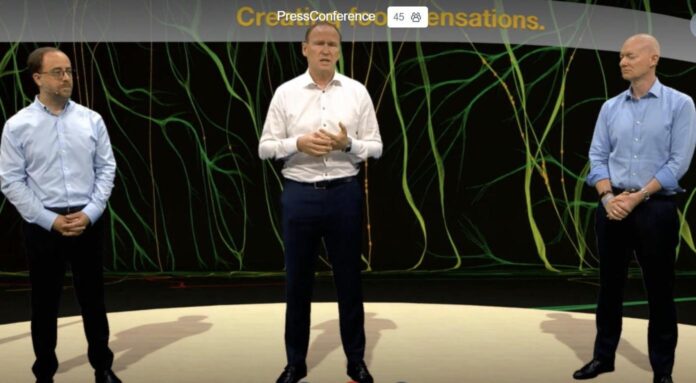
A virtual press conference preceded Bühler's opening of its online 'Creating Food Sensations' event. The event, which fills the void for the company due to the delayed Dusseldorf Interpack Processing and Packaging Exhibition moving from May 7-13, 2020 to February 25-March 2, 2021, drew together over 40 journalists from around the world.
Milling and Grain reported the Press Conference through its news blog earlier today, however following the presentations journalists were invited to ask questions.
Here we report in brief – and abridged – on questions and answers put to the Bühler team which comprised: Stefan Scheiber, CEO Bühler Group Ian Roberts, CTO Bühler Group and Germar Wacker, CEO Consumer Foods.
Q: What does 'resilience' mean and what can Buhler to contribute to greater 'resilience?'
A: Stefan Scheiber, CEO Bühler Group – Over the past weeks or months we could not travel yet for most customers in the food sector they had to be up and running as all consumers needed food. It is important that we remain supportive of our customers, through our 90 service stations. We work with our local people who are allowed to connect to our customers. That means we could support them with parts, consulting and even installation of complete plants using VR technology and in some cases with our staff carrying out work they were not necessarily expert in doing but able to with the supply of appropriate tools.
Q: What is the cost to your business position, positive or negative, of the Covid-19 pandemic?
A: Stefan Scheiber, CEO Bühler Group – Overall on growth we are affected. Our orders are down by 25 percent. This does impact our business in some areas more than others. Die casting for example has been severely affected. As you all know some big OEM have shut their production, but we have other areas in our business that have been working.
A: Germar Wacker, CEO Consumer Foods – If you look at our range of customers it strongly depends on which region they are in, the food channels they use, how high their capacity is to meet consumer demand.
They might have to face setbacks in face of their business processes. It is our job to support our customers wherever they are and those who are in that range to be close to them, support them in business resilience and help them reach maximum capacities and to look forward to new potentials. A lot of businesses are trying to keep liquidity protected but from the enquiries we are receiving it gives me a good feeling for a bounce back once we are out of this current situation.
A: Ian Roberts, CTO Bühler Group – We see the demand for plant-based meat analogues growing globally, it's an extraordinary transition in terms of human demand. In 30 years in this industry I haven't seen such a mass pull towards a totally new category. So we are serving many of the companies bringing out these innovations – plant-based chicken replacements, plant-based burgers and plant-based sausages and we see these popping up all over the world.
These are coming thick and fast and the demand for these is very high and a lot of that is built on our base technologies, and not only extrusion lines with their shaping and forming technology, but of course there is also the primary processing around pulses, soy, lentils that is also a strong part of our portfolio. The capability of joining that technology group with extrusion and the shaping allows us to take a complete value chain approach while supporting companies as they build up their portfolios.
Q: Should the food industry play a greater role with governments to ensure food is supplied to all parts of the world, particularly to production plant facilities. What role does the industry have to play?
A: Stefan Scheiber, CEO Bühler Group – I think governments, industry and academia together with scientific research must communicate to pull people together to exchange learnings. Only through this collaboration will we be able to come up with solutions to feed and nourish 10 billion people over the years to come.
The impact on the climate that we can measure already shows limitations on how grains are grown and where they can be grown. At the same time the population keeps on growing.
I think what we have now seen in the coronavirus is that wise governments linked up with research and scientific support shows this collaboration to have been very successful, very trustful in mastering the crisis. They have been very successful. In their absence it has been less successful.
Register for the Bühler Virtual World Conference, HERE.
Create an account
Welcome! Register for an account
A password will be e-mailed to you.
Password recovery
Recover your password
A password will be e-mailed to you.
REGISTER HERE: Q&A at Buhler’s ‘Creating Food Sensations’ press conference
Subscribe to our newsletter to get the latest news from industry
DOWNLOAD OUR APP