































by Mildred Cookson, Mills Archive Trust, UK
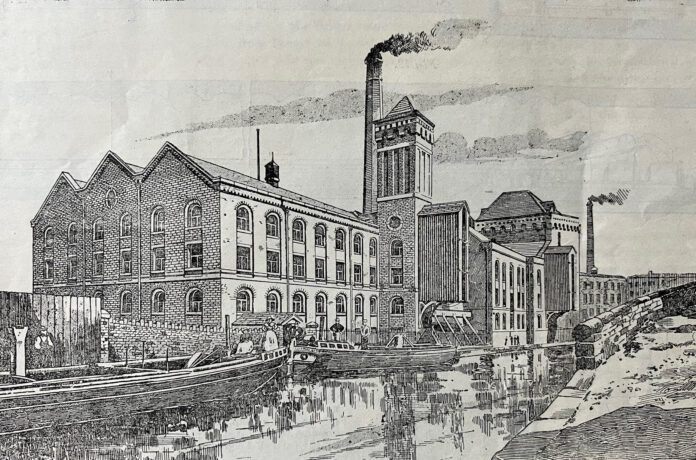
Joseph Appleby & Sons’ Daisyfield mill was remodelled in the spring of 1893 as recounted in an article in The Miller of fifth June that year. The work was carried out by Whitmore & Binyon of Mark Lane, London & the Iron Works, Wicken Market, Suffolk. At that time Edgar Appleby, a partner in the firm, was President-elect of the National Association of British and Irish Millers.
The mills were well situated for receiving raw materials and for distributing manufactured products, having on one side a water carriage and on the other a siding of the Lancashire & Yorkshire railway which could take goods to any part of the UK.
The remodelling was supervised by George Binyon, partner in the engineering firm from Suffolk. The flour produced was most satisfactory and credited to the thought and care lavished on the arrangement of the various machines forming the plant. The mill was designed to produce 25 to 28 sacks of flour per hour but sometimes could reach 29.5 sacks.
State-of-the-art roller plant
The roller plant was set up in the five-floor building between the warehouse and the wheat cleaning departments. The ground floor of the mill hosted the main drive and the 34 elevators that took the different products as they were received to other machines on the floors above for the next step in the gradual reduction process of wheat to flour and offal.
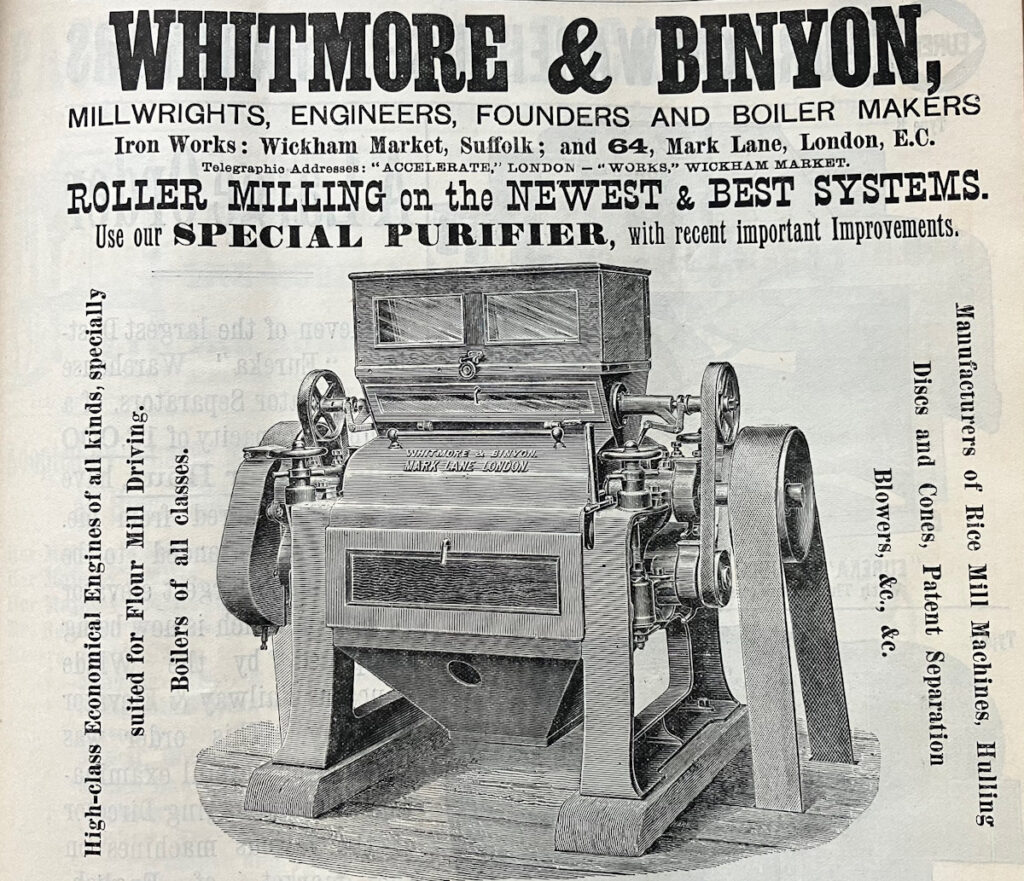
On the first floor 31 roller mills were arranged for 12 reductions of the wheat on the system of five breaks. The flouring of middling and dunst, and the reduction of the semolina in 12 reductions were performed on eighteen Whitmore and Binyon double roller mills, with four smooth chilled iron rolls 30 x 10 inches. The first break was performed on two of Simon’s double roller mills, each was fitted with four grooved chilled iron rolls, 40 x 10 inches. The third break was produced on three of Gray’s double roller mills, one of which was fitted with four grooved rolls, 30 x 10 inches and the other two with four rolls each 18 x 9 inches, and a Whitmore & Binyon double roller mill with grooved rolls 30 x 10 inches. The fourth and fifth breaks were carried out on five double roller mills with grooved rolls 30 x 10 inches, each break taking two and a half machines. This floor also accommodated five sets of hurstings by which the five sets of millstones on the floor above were driven along with a line of shafting driven by seven ropes.
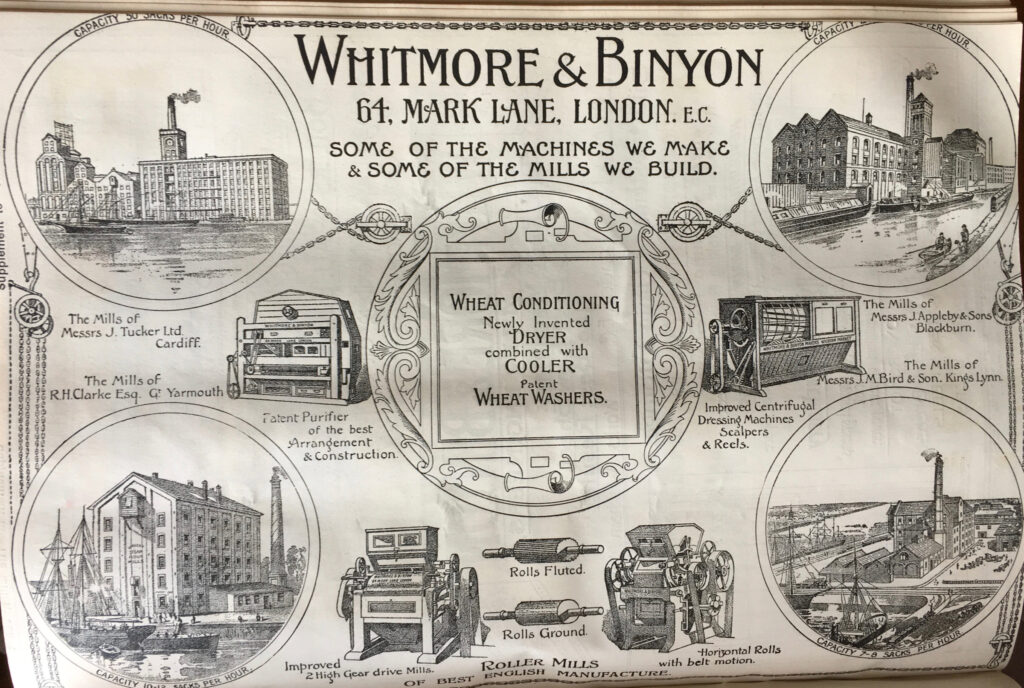
The second floor had a Tomlinson’s grader with aspirator to grade and aspirate the wheat before it passed on to the first break roller mills; 10 scalping reels on which the five breaks were sifted, two scalpers to each break, nine special ‘Victoria’ sieve purifiers, three of Goodall’s sieve purifiers, an arrangement for measuring the flow of cleaned wheat into the roller mill and five pairs of millstones for gristing purposes.
The third floor had eleven centrifugal dressing machines, an ‘Impact’ dresser, four dickey sieves, five of Goodall’s Sieve purifiers, seven ‘Victoria’ sieve purifiers, the hopper bins containing the material to be ground on the millstones and three lines of shafting, one of which was driven by ropes and from which the other two shafts took their power by means of beltings.
The fourth floor had ten centrifuges for flour dressing, two for bran, four dickey sieves and six of Gray’s flour dressers. The top floor of the mill had 12 Gray’s flour dressers, four centrifugal flour dressing machines and a wheat conveying worm.


Advanced wheat cleaning & storage
The wheat cleaning department was in a separate building from the roller mill and adjoined the silo building. The department housed three processes of cleaning. Two double eccentric grain separators, a Howarth’s heater with fan and a cooler, four Bedford’s wheat scourers in one frame, two Van Gelder washers each with two whizzers, a Victor brush machine, 26 cockle and barley cylinders, two throop brush machines and a rock separator. On the bottom floor of the department a Tomlinson’s wheat weighing mixer with eight hoppers, arranged to receive the wheat from the silo bins and mix it in the desired proportions by weight.
The silo building was the furthest away from the roller mill. The wheat was received and elevated to the top floor and after being weighed discharged to one of twelve square silo bins below. The silo was constructed of timber on the American system and around 70 ft deep capable of holding around 12,000 quarters.
The motive power came from a twin compound beam steam engine of 600 horsepower. A 40-tonne flywheel was placed between the two engines and was driven by the two cranks placed at right angles. The steam to drive these engines was provided by two boilers 7.6 ft. x 26 ft. long giving a working pressure of 70 psi.


The whole premises were fitted out with ‘Grinnell’ automatic sprinklers, the water supplied from the town’s main and from an elevated tank at a height of 15 ft above the highest sprinkler.
Messers Appleby & Sons were the first millers to adopt sprinkler protection in the country, installed in 1887, and as the new plant was installed this was overhauled, extended and brought up to the existing insurance requirements with the new glass valve ‘Grinnell’ head introduced by Messers Dowson, Taylor and Co Ltd., of London and Manchester.
Published in the December 2024 issue of Milling and Grain.