



























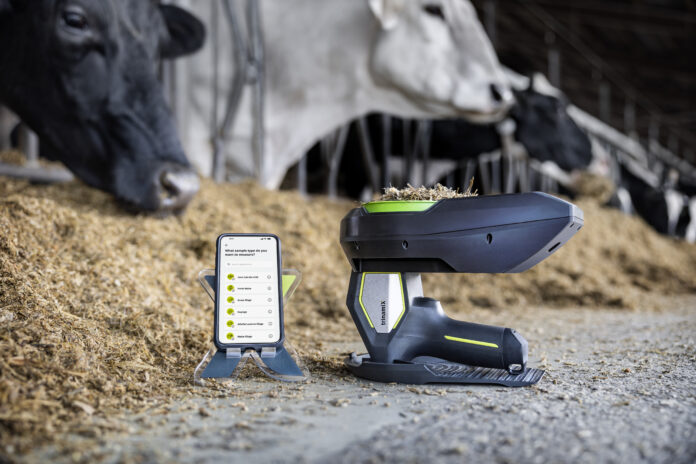
Eurofins Agro and trinamiX GmbH have announced a significant expansion of their joint mobile forage analysis solution, delivering broader geographic availability and enhanced analytical capabilities for dairy and cattle farmers across Europe.
The mobile forage analysis applications running on the trinamiX PAL Two spectrometer are now available in four additional major farming regions: France, Italy, Portugal, and Spain. The solution is already licensed in countries including Austria, Belgium, Denmark, Finland, Germany, Great Britain, Luxembourg, Ireland, the Netherlands, Norway, Poland, Sweden, and Switzerland.
This expansion brings mobile feed evaluation to a rapidly growing market of dairy and beef producers, enabling them to make faster, data-driven decisions directly on the farm.
Starting March 2026, energy values will be consistently available across all Eurofins forage applications running on the trinamiX PAL Two. For dairy farmers, balanced energy intake is closely linked to milk yield, milk quality, fertility, and overall herd health. For cattle producers, energy content drives growth rates, feed efficiency, carcass quality, and production costs.
With standardised energy data, farmers can directly compare feedstuffs by energy per kilogram, optimise ration balancing to avoid over- or under-feeding, and improve cost efficiency while promoting animal welfare and more sustainable use of resources.
The forage portfolio has been further expanded with the addition of alfalfa/lucerne silage, a key feed component for high-performance dairy herds. Alfalfa is valued for its high protein content, energy levels, and digestible fibres. It reduces the need for synthetic fertilisers and supports soil regeneration.
The full set of available forage applications now includes fresh maize, maize silage, corn cob mix (CCM), haylage, grass and clover silage, fresh grass and clover, hay, and alfalfa/lucerne silage.
Using trinamiX’s mobile near-infrared (NIR) spectroscopy technology combined with Eurofins’ calibration expertise, farmers gain lab-grade insights directly in the field, at the silage clamp, or in the feed alley. This accelerates decision-making and allows on-site adjustments to feed rations and harvesting strategies.