
























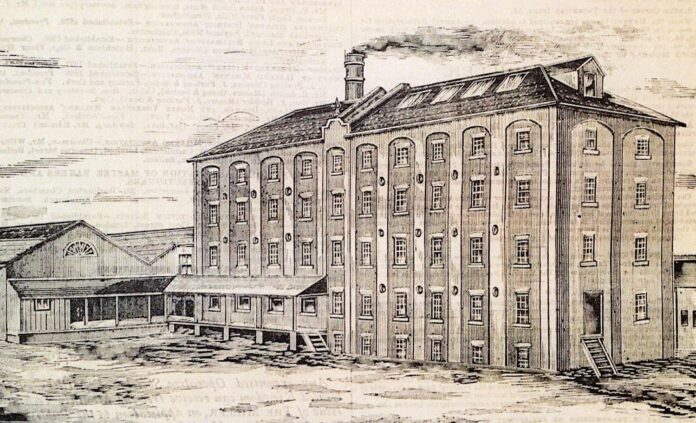
The MILLER July 4th 1892 reported that Easter Monday that year was a memorable day in the town of Orange, New South Wales, as it witnessed the starting up of the new roller mill of Mr. James Dalton. Dalton was already a well-known Australian miller and had watched the erection of his mill for the previous twelve months.
The opening ceremony was carried out by James' daughters. The two Miss Daltons turned on the feed and the mill began operating. At the reception which followed, an elaborate lunch for 400 people, James Dalton told his guests the day was also special for him too as it marked the day that 26 years earlier, he had started the old millstone mill.
The old mill had done good service for over 20 years, but as the roller mill system was beginning to make its way into Australia, he found business slipping away from him, even though he had the best cleaning machinery and a set of rollers. As he was not yet ready to retire, he decided to install a complete roller plant.
After consulting Nelson and Co of Sydney, it appeared to him that it would be best to erect an entirely new building. As for the plant itself, after inspecting German, American and English roller systems, he believed he had chosen the best machinery obtainable. This comment brought cheers from the guests. Mr Nelson remarked that this new mill would be an incentive to neighbouring farmers to grow wheat, as it would be capable of milling one million bushels of cereal in the course of a year.
The old mill was utilised for a double purpose; the flour or finished product stores where located at the end nearest the new mill, while at the further end the silos received the raw material and wheat. The silos extended from the top of the building to the level of the first floor and were provided with slides for drawing off the wheat, to be received by a worm and conveyed to the cleaning department which was formerly the engine room of the old mill.
The new engine house at the back of mill contained a pair of engines made by Fowler & Sons, of Leeds, capable of developing 350 hp. The power was taken off by 12 two inch cotton ropes that passed around a driving wheel of 16 feet diameter. The latter was supplied by Hind & Lund, milling engineers of the Atlas Works, Preston Lancashire.
There was no door opening from the mill into the engine house; communication between the two departments was by means of electric indicators which, at the touch of a button, the engineer could read a dial to either stand by, stop or go ahead. Steam was supplied by two Lancashire boilers.
The newly erected mill itself was brick built in cement to the first floor, 51 feet in length and 30 feet wide and rising to 60 feet and six inches at its extreme height. The basement was 10 feet deep with a floor of concrete and cement. In the basement sixteen sets of elevator bottoms fed the machines in the floors above. The whole milling plant was supplied by Hind and Lund and erected on their well-known system.
The first floor had five double break rollers fitted with rolls of 40 x 10 inches. These were said to exceed in dimensions all the rolls in the colony. At the opposite end of this floor were nine sets of smooth rolls for middlings reduction, each roll measuring 25 x 10 inches.
The one outstanding feature was the finished work in mahogany casings of the rolls, said to be admired by all who saw them. It should be noted that while the break roller mills were driven from one shaft, power was transmitted to the sets of smooth rolls by another shaft.
With the exception of the first break roller mill, each set of rolls was fitted with an exhaust spout which communicated with one of the two trunks that each passed to the floor above. There they delivered their dust to an 'Ince' patent collector, which in turn passed the dust into a worm that conveyed this material to a point where it was sacked.
The grease, dirt and other impurities released by the first set of break rolls were removed from the casing by means of two spouts which passed into a trunk, one end of which held a suction fan.
On the second floor were six Hind and Lund 'Atlas 'purifiers. They were favoured as there was no need for dust chambers or spouts. On the third floor there were seven centrifugals and four scalpers, again all by Hind and Lund, and on the fourth floor were eight centrifugals and three reels.
The mill was automatic throughout and the finished products, flour and bran, were sacked on the ground floor in flour and bran packers. The sacked products were stored in the old mill at the opposite end to the wheat silos, which were in close to the wheat cleaning department. The capacity of the mill was 25 bags per hour.