
























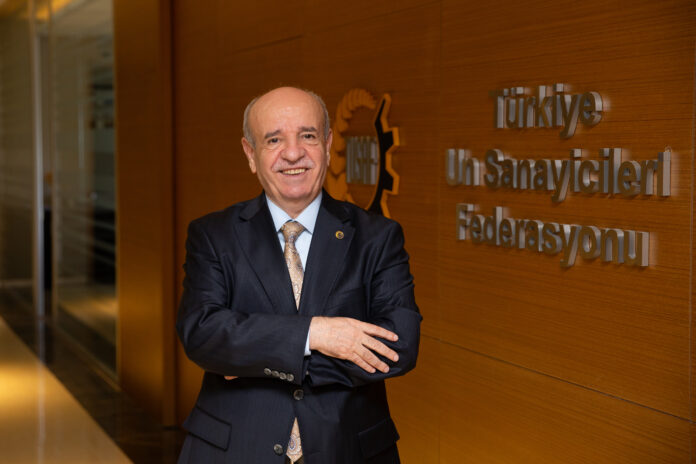
Mesut Çakmak was born in the Patnos district of Ağrı Province, Türkiye, in 1957. He entered the workforce at the age of 16. The experience he gained at an early age contributed significantly to his future success in the business world. Çakmak began his industrial career with Beşler Un in 1991. Today, he serves as Chairman of the Board at Beşler Group, one of Turkey’s largest food producers, and is also actively involved in numerous non-governmental organisations.
Could you share your views on the current state of the local flour market in Türkiye? How are consumer preferences evolving?
The local flour market in Türkiye has a sensitive structure that is influenced by global fluctuations and domestic market dynamics. In recent years, increasing input costs, logistics challenges, and agricultural risks such as drought have directly affected the domestic market. Nevertheless, since flour production is a fundamental branch of the food industry, local demand has remained stable.
Consumer preferences, however, have begun to diversify significantly. There is now rising demand not only for traditional white flour but also for functional and health-oriented products such as whole wheat flour, einkorn flour and gluten-free alternatives. This shift is driven by growing health awareness, changing dietary habits and increased consumer interest in product content. The move toward packaged products in retail is also part of this transformation.
It should be noted, however, that this shift is more visible in major cities. In many parts of Anatolia, traditional products remain more popular. Therefore, it is crucial for producers to take regional preferences and local consumption habits into account when planning production.
As the chairman of the TUSAF Board, what will be your main focus areas in the coming period?
From the very first day of our tenure, we have created a clear roadmap covering the 2025–2028 period. This roadmap focuses on four key priorities.
The first is maintaining our leadership in exports. Türkiye has been the world leader in flour exports for the past 12 years. However, the recent decline in exports has shown us that sustaining this leadership now requires much greater effort and innovation. By analysing strategic markets, foreign trade policies and our logistical advantages, we aim to regain lost markets and expand into new ones.
Our second focus is sectoral transformation—specifically the “twin transition,” meaning digitalization and green transformation. These are no longer optional but mandatory. Sustainable production models, energy efficiency and reducing the carbon footprint will be among our top priorities in the coming period.
Our next priority is addressing structural challenges. Idle capacity in the sector exceeds 50 percent, which is a serious concern. To enhance the competitiveness of companies, we are in direct dialogue with public institutions to ensure better capacity planning, improve access to financing and stabilize raw material supply.
Finally, we aim to transfer knowledge to younger generations. The sector has a deep well of expertise, but we must do more to pass this on and attract young talent. As TUSAF, we plan to expand training programs, technical visits and university–industry collaborations.
Sustainability is becoming increasingly important across all industries. What steps should Turkish flour mills take to reduce their environmental impact?
Sustainability has become a strategic necessity for all industrial sectors, and the Turkish flour industry must strengthen its focus in this area in the coming years. Investments in energy efficiency, water use, waste management and reducing carbon emissions will not only generate environmental benefits but also create competitive advantages.
Some leading companies have already taken steps in areas such as renewable energy use, waste heat recovery and digital production tracking. However, these practices need to be scaled up across the industry. Under the twin transition (digitalisation and green transformation), establishing systems that optimize resource use and digital infrastructures that ensure traceability is now inevitable.
International regulations such as the Green Deal will directly affect our exporting companies, which is why these topics will remain among the key areas we support as a federation in the coming period.
How are global trends—such as changing wheat prices and international trade policies—affecting Türkiye’s flour industry and your work?
Wheat prices are among the most critical factors for our sector. While last year’s harvest was around 21 million tonnes, we expect a lower yield this year due to drought and frost. The sales prices recently announced by the Turkish Grain Board (TMO) at the beginning of October are, in our view, balanced for the industry.
International trade policies have a direct impact on our exports. For example, the trade restrictions implemented in mid-2024 caused a nearly 30 percent decline in flour exports. Such interventions make it difficult to maintain market stability. In addition, unfair taxation and non-tariff barriers in key markets such as Iraq reduce our competitiveness.
Given the aggressive export policies of countries like Russia and Egypt, Türkiye needs a more strategic and coordinated export policy. In this regard, TUSAF continues to provide policy recommendations to public authorities and guide sector stakeholders toward alternative markets.
What do you see as the biggest opportunities and challenges facing the Turkish flour industry, and what initiatives are TUSAF implementing or planning to support them?
The Turkish flour industry has significant advantages in strategic markets such as the Middle East, Africa and Central Asia, thanks to its strong quality standards and production experience. Our geographic location, logistical advantages and cultural ties further strengthen our export potential, while in the domestic market, a young population and growing demand for functional products offer new opportunities.
However, the sector also faces serious challenges. Idle capacity exceeding 50 percent, supply instability driven by climate change and uncertainties in foreign trade, all threaten long-term sustainability. Moreover, unfair tax practices in certain markets undermine our export power.
At TUSAF, we have established working groups to collect issues directly from the field and convey them to the relevant institutions. We are increasing awareness and training activities to guide producers in digitalisation, sustainability and foreign trade, and we are planning collaborations with universities to attract young professionals to the industry. Reclaiming lost markets and strengthening exports through coordinated public–private strategies remain among our top priorities.
Could you tell us about the “Extended Sector Meeting” held between 2-5 October? How did it go, how many participants did you have and what key messages did you share?
As is well known, every year our member associations hold post-harvest evaluation meetings. This year, we organized the event in Gaziantep under the theme “Post-Harvest Future Projections”, hosted by the Çukurova Flour Industrialists Association (ÇUSD) and the Southeastern Flour Industrialists Association (GUSAD).
On behalf of our umbrella organization TUSAF and my esteemed association, we had the pleasure of welcoming over 550 participants. We visited some of the city’s most notable landmarks, experienced its rich local cuisine and exchanged insights with key stakeholders such as the Turkish Grain Board (TMO), public institutions and sector representatives at this important post-harvest stage.
I would like to extend my sincere gratitude to all participants, institutions and sponsors who supported and accompanied us throughout this successful event.
What would you like to share about the upcoming 20th TUSAF International Congress and Exhibition next year?
As one of the largest non-governmental organizations in Türkiye’s food industry, we place great importance on creating platforms for consultation and collaboration to find solutions to sectoral challenges.
In this context, the Turkish Flour Industrialists Federation (TUSAF) will host its 20th International Congress and Exhibition under the theme “Climate Resilience and the Future of Trade”, to be held 12-15 February 2026 at the Kaya Palazzo Hotel in Antalya.
Having hosted over 1500 guests in the past two years as Türkiye’s largest food congress, we are proud to continue bringing together industry leaders, experts and stakeholders to shape the future of our sector.