






























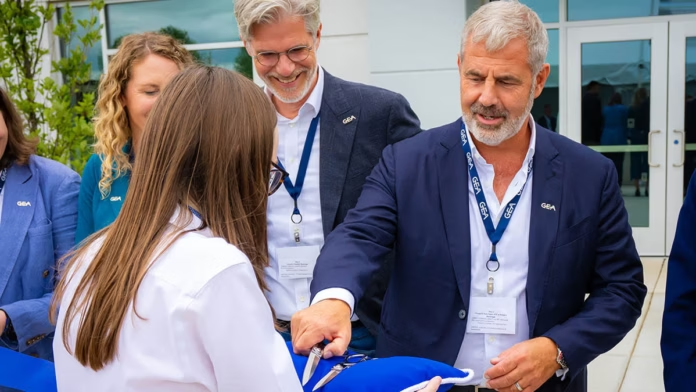
GEA has unveiled its New Food Application and Technology Centre (ATC) in Janesville, Wisconsin, aimed at scaling up the production of alternative proteins. The facility, which opened on July 17, 2025, is part of a USD 20 million investment and represents GEA’s commitment to sustainable food solutions that serve as alternatives to traditional meat, dairy, seafood, and eggs.
This centre is GEA’s second global hub dedicated to food technology, following the launch of its first ATC in Hildesheim, Germany, in 2023. The Janesville facility expands GEA Janesville’s existing campus and is powered by 100% renewable energy.
The ATC features pilot-scale infrastructure for advanced food technologies, including precision fermentation, cell cultivation, and plant-based processing. It bridges the gap between laboratory innovation and industrial production, allowing companies to test and optimise their processes early on. Key technologies at the facility include pilot bioreactors, thermal processing, and membrane filtration, all crucial for ensuring food quality and safety.
“The food industry is at a crossroads. To feed future generations sustainably, we must turn vision into a scalable reality. Our new centre in Janesville is a key milestone on our shared journey – both for our customers and for us as a company,” stated Stefan Klebert, CEO of GEA Group. He emphasised that the centre will help scale the production of innovative foods, such as precision-fermented egg white and cultivated seafood.
The establishment of this centre is expected to create new skilled jobs in Janesville, particularly in engineering and science, complementing GEA’s current workforce of 74 employees. The construction also generated up to 500 jobs for contractors and subcontractors, thereby enhancing the local food technology ecosystem.
“This facility reflects how Janesville’s rich agricultural and industrial heritage can intersect with cutting-edge innovation,” said Jimsi Kuborn, Economic Development Director for the City of Janesville.
Kuborn suggested that the project not only honours the community’s roots but also creates new opportunities for partnerships, workforce development, and sustainable growth. She said that this project served as a model for what could be achieved, not just for Janesville, but for the entire Midwest and beyond.
“GEA technology hubs are the crucible where visionary science becomes transformative industry, uniting biological innovation with cutting-edge engineering to move towards a more sustainable future,” said Prof. Yaakov Nahmias, Director, Grass Centre for Bioengineering at the Hebrew University of Jerusalem.
Jessica Almy, Interim CEO of The Good Food Institute in North America, noted that the Janesville centre exemplifies how agriculture and innovation can work together to enhance food security, create good jobs, and tackle climate challenges.
“It contributes to positioning the American Midwest at the forefront of food innovation,” Almy said.
As the U.S. leads in alternative protein investments, Wisconsin positions itself as a significant player in this emerging field, further merging traditional agriculture with advanced biotechnology and sustainable manufacturing.