
























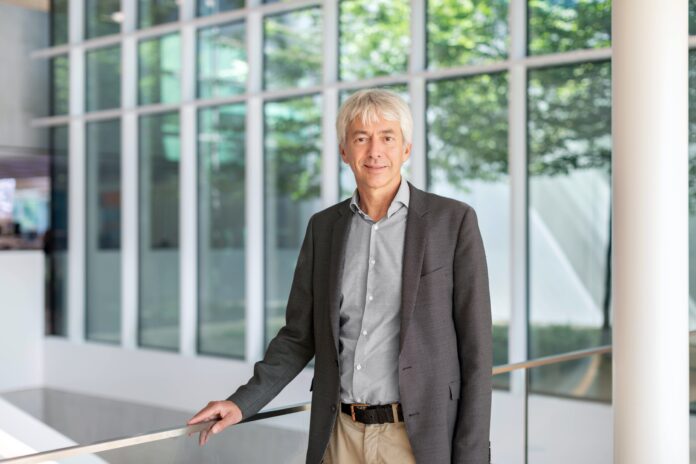

After more than a decade leading Bühler Group’s Grains & Food business and over 25 years in CEO roles across global industries, Johannes Wick has stepped down from the Executive Board, closing a remarkable chapter in the company’s history. From energy and infrastructure to grain milling and global food systems, Wick’s career has come, as he describes it, “a full circle.”
A purpose-driven move
Wick joined Bühler in 2014, initially taking over the management of Grain Milling, the company’s largest business area. At the time, his move from the energy sector surprised some observers. But for Wick, the decision was instinctive. “I grew up in the neighborhood of Bühler’s headquarters in Switzerland, so I have always had personal connections with employees from the company. After university I decided to work in the energy sector, which is also a highly dynamic industry. However, when Bühler called me, I did not hesitate. Contributing to feeding the world in a sustainable, nutritious, and affordable way is the most noble purpose you can have.”
Throughout his professional life, Wick says he sought to contribute to a more sustainable global system. “Throughout my professional career, I was happy to contribute to a global sustainable food system. What Bühler offers is at the center of people’s needs – food and mobility. Having worked in the energy sector before, I feel like my career has come a full circle.”
Energy efficiency and smarter mills
When Wick first stepped into the milling business, he identified mill construction and energy use as two areas ripe for improvement. At the time, sustainability and energy efficiency were not yet universal priorities. “When we did that interview, there were probably only a few people in the industry who had those priorities. Today, I feel that in all investment projects, customers are concerned about energy efficiency. The whole industry has evolved in that regard over the last decade.”
Under his leadership, Bühler introduced digital solutions to optimise operations, new mill designs requiring far less site work, digital offerings supporting the journey toward the SmartMill, and integrated product innovations such as the Arrius. Over the same period, the company increased its global market share in milling.
Reflecting on his own contribution, Wick remains characteristically measured: “Now, have I been successful? I leave this to other people to judge. What I can say is this: The responses and feedback I received from both customers and Bühler employees after I announced that I would step down were simply mind-blowing and overwhelmingly positive.”
Navigating waves of global investment
Wick’s tenure coincided with extraordinary volatility in global markets, particularly during and after the Covid-19 pandemic. “The market has certainly been very dynamic, especially since Covid. It is extraordinary how big the shifts were between segments and regions.” He points to dramatic regional investment waves: first China after Covid, followed by a surge in the Americas, and in 2025, a strong wave in Africa. Segment-wise, investment moved rapidly between chocolate, flour milling, pasta, cocoa processing, and animal feed.
“These fast-changing investment patterns are, on the one hand, extraordinarily challenging as almost every day you need different people with different skills at different locations. On the other hand, they present major opportunities to outperform the competition. I believe Bühler has shown remarkable agility in these dynamic markets”, he says.
One constant amid the volatility has been the need for education and training. Wick emphasises that Bühler has continuously invested in educational infrastructure and curricula, offering what he describes as its most complete advanced training portfolio ever, for both employees and customers.
New generation of leadership
Looking ahead, Wick sees an industry at a tipping point. Customer requirements are evolving, competitive landscapes are shifting and globalisation is no longer a one-size-fits-all model. “For the grains and food industry, the overarching challenge is to provide effective, sustainable, and affordable solutions in a short time.”
He notes the stark contrast between fast-growing regions and mature markets with aging populations. Digitalisation, AI, decentralised footprints, and customer proximity will be decisive. At the same time, he sees enormous untapped potential in upgrading existing assets improving efficiency, reducing downtime, enhancing food safety and quality and cutting energy consumption.
Leadership of the Grains & Food business now passes to Mike Haefeli, a Bühler veteran of more than 25 years. Wick expresses full confidence in the transition, describing Haefeli as deeply familiar with both markets and Bühler’s positioning.
Sustainability: proof and pressure
On the question of sustainability, Wick is cautiously optimistic. He sees clear progress but also recognises the need for continued urgency. “It is great to see that in all markets some industry leaders are going ahead and taking fantastic action. They have proven that strong actions that continuously improve sustainability are at the same time a business case and contribute to improved financial results”, he says.
He notes that sustainability leaders benefit from easier financing, premium pricing, and lower operational costs through efficiency gains. Many of Bühler’s solutions have emerged from co-creation workshops with customers. Still, he stresses that “further efforts are needed,” and that the journey toward concepts such as the SmartMill “will continue and Bühler is committed to drive this with full power.” The limited availability of skilled labor, he adds, makes digital and efficiency solutions even more critical.
A new role, a familiar mission
Though stepping down from the Executive Board, Wick is not leaving Bühler. In his new role as Strategic Project Executive, he aims to elevate project execution across the organisation. “Generally, I want to enable Bühler to bring the entire project execution to the next level.” He plans to coach younger project managers in building robust project strategies and anticipating potential friction points. “My premise has always been that the art of project management is to anticipate problems and solve them before they occur.”
Wick also intends to engage in larger, more complex projects and to support customers in shaping their initiatives. His overarching objective remains clear: “Overall, my goal is always to achieve a step change in the reduction of construction time in order to enable faster production combined with a reduction in overall Capex. These two drivers often go hand in hand as time is one of the biggest contributors to cost.”
A legacy of agility and purpose
Johannes Wick’s leadership at Bühler has been defined by agility in volatile markets, an early and consistent focus on energy efficiency, and a belief that sustainability and profitability can and must go hand in hand. As he transitions into a strategic advisory role, his influence on the global grains and food industry continues, less from the boardroom spotlight, perhaps, but still firmly at the heart of the action.