



























by Janet Anderson, Senior Editor, Bühler Group, Switzerland
First published in Diagram, Bühler’s in-house magazine. Republished with permission.
Just over an hour by train from Berlin, Germany, lies the unique historic landscape of the Spreewald. Here, the River Spree branches into countless small waterways before flowing toward the capital. Declared a UNESCO Biosphere Reserve in 1991, the region has developed into a thriving hub for the food industry. One of its success stories is the Gebrüder Kümmel oat plant in Vetschau – a business whose history mirrors the social, economic and technological shifts of recent decades, while also reflecting the entrepreneurial skill and innovative spirit of the region.
Deeply rooted in the Spreewald community, Gebrüder Kümmel is a family business spanning three generations of millers. In 1957, Uwe and Frank Kümmel’s grandfather purchased a small mill in Burg, where rye, wheat and spelt were milled using traditional processes. From early childhood, the brothers grew up in the mill, and with the trade of milling deeply embedded in their identity.
Alongside this strong sense of tradition, the family has always embraced change. Time and again, they have put this into practice – from the early days of the business to the ambitious expansion of their new Plant 3, a project designed to secure the company’s long-term future.

A milling family set on future success
The family’s entrepreneurial spirit shone through even in difficult times. The reunification of Germany in 1990 brought with it sweeping social and economic upheaval that the business felt firsthand. “With the reunification, our products were no longer in demand,” says Uwe Kümmel, Co-Managing Director of Gebrüder Kümmel. “We had to explore new business areas and expand our portfolio.” The company pivoted to producing barley groats, used in the making of Grützwurst (a kind of sausage). This was soon followed by other new product areas such as buckwheat processing. The growing demand confirmed the wisdom of the decision.
“Our growth has been founded, from the very beginning, on the principle that we always listen to what our customers want,” says Frank Kümmel, Uwe’s brother who is Co-Managing Director and CFO. “We never say ‘impossible’. If a customer comes to us with a problem they can’t solve, we work to find a way to solve it – and in most cases, we’ve succeeded. That’s something we’re hugely proud of.”

Listening to the market
To meet changing market needs and the rising demand for oat, spelt and similar products, the family decided to move into the next generation of oat processing. But the old Burg site was too small. In Vetschau, they found a suitable property with buildings that could be adapted. Early on, the brothers committed to producing gluten–free and organic products – a smart move that anticipated consumer trends.
Shifting dietary habits and new finished products such as oat drinks have since boosted their business. A new facility for oat production was planned, and a 12–story structure began to rise. At its core was the vision of a ‘transparent mill,’ with digital processes designed to optimise efficiency.
Building a transparent mill
“Our goal was to build a transparent plant with Bühler,” explains Robert Kümmel, Master Miller at the plant and representative of the next generation of the family. The 26-year-old is determined to drive the company’s digital transformation. “By integrating Bühler Insights and more than 30 scales that constantly monitor product parameters and alert us to deviations, we can respond quickly to changes and keep a constant eye on the quality of our product,” he says.
For Randy Urban, Head of Sales Grain Processing at Bühler Germany, who worked closely on the project, the realisation of this vision by the plant will have even wider benefits. “Our shared vision was the creation of a fully transparent, smart oat mill,” he explains. “I believe this step is a key success factor not only for Gebrüder Kümmel’s future, but for the oat industry as a whole.”
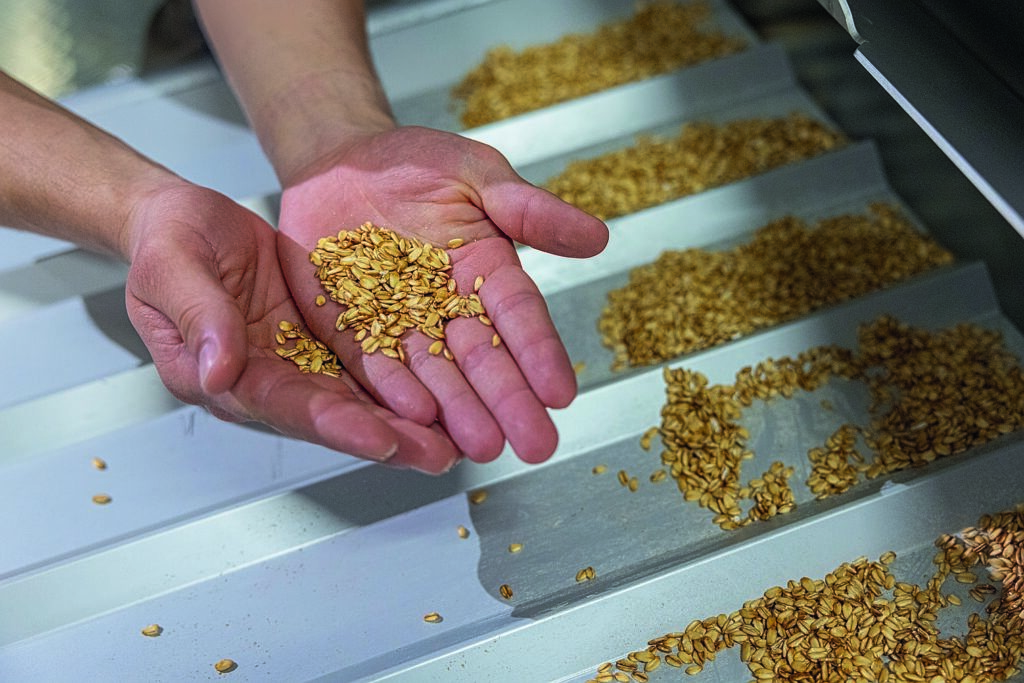
The new plant is an all-in-one solution covering everything from intake, cleaning, kilning, dehulling, cutting, flaking, and grinding to bagging and loading – all customised to the Kümmel family’s needs. One of the first challenges was integrating the installation into an existing building. Using full 3D scans of all floors, Bühler designed the optimal layout. Conveyor routes, for example, were kept as short and as efficient as possible. “We worked with the Bühler team to develop ideas and incorporate the latest technological advances,” says Uwe Kümmel.
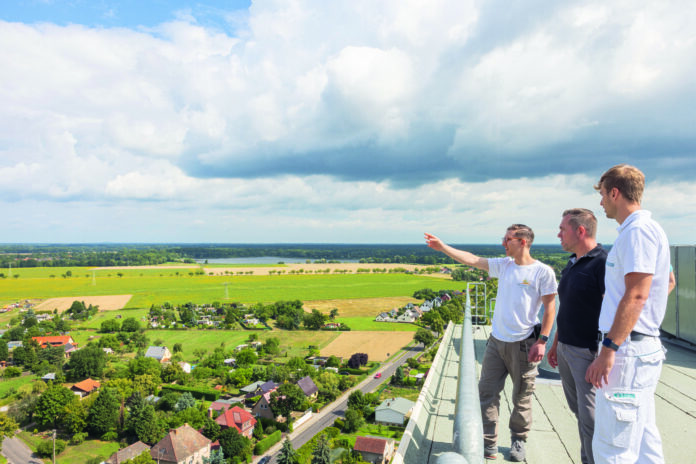
For Paul Heine, Senior Process Engineer Oats at Bühler, those early site visits were invaluable. “Walking through the empty building with Uwe Kümmel and envisioning each component and the finished plant was a hugely enriching process,” he says. The building’s height – with views from the 12th floor stretching far across the surrounding country-side – is ideal for energy-efficient flow of materials. Raw oats are lifted to the 11th floor and then processed largely ‘by gravity,’ cascading floor by floor until the finished product arrives at ground level. The result is maximum energy savings, improved margins and a smaller carbon footprint.
Kilning at the highest level
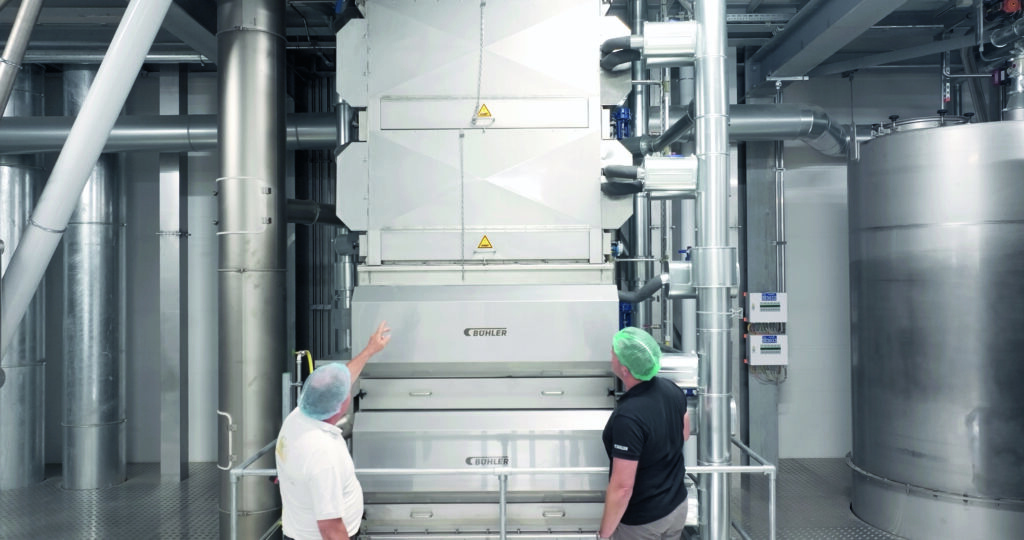
The plant includes a raw oat kiln that improves yield and flavour and delivers a lighter coloured final product. Spanning nine floors, it is the tallest Bühler has ever installed. The oats are then flaked using the premium PolyFlake flaking mill. “We debated extensively which kiln to use. Should we, like other mills, kiln only hulled oats, or go a different route with raw oat kilning? That was a key question,” Uwe Kümmel says.
“We opted for the raw oat kiln. It allows us to kiln unhulled oats, which adds depth to the flakes’ flavour profile. We also expect it to give us a market edge by enabling us to meet our customers’ requirements more exactly.” Next, the oats pass through five hullers. “They’re the heart of the mill,” says Heine. “The quality of dehulling is critical – precision is everything.”
The ‘hullability’ of the oats varies according to the harvest. Lab technicians therefore test samples from each delivery using the prototype lab dehuller before the raw oats even enter the plant. This innovation simulates the actual dehulling process with much greater accuracy than conventional methods, enabling the millers to set the correct parameters in the mill that will minimise breakage and maximise yield for each batch.
The new oat mill demonstrates how sustainability and profitability can go hand in hand – from reduced energy use to fewer byproducts. Multiple optical sorters, including Sortex H SpectraVision, guarantee gluten-free quality. But perhaps the greatest breakthrough is the new level of transparency in the operations. Over 30 scales collect process data, enabling optimal control and rapid response. Variations in yield or process parameters are continuously and precisely tracked.
The Varion G fully automatic loss-in-weight scale which runs without compressed air and measures moisture, temperature and bulk density enhances both energy efficiency and product quality. That’s good for business, and good for the environment.

Higher yields, lower footprint
“It’s important to constantly consider how energy consumption can be reduced, or how raw materials can be cultivated more efficiently – ideally with shorter transport routes,” says Uwe Kümmel. “My main focus is to strengthen local cultivation and promote winter oat varieties suited to regional soils. That way we can boost agricultural success while achieving high yields and efficient processing.”
Even during the early phase of commissioning, the plant delivered higher yields with improved hygienic conditions. The facility operates with outstanding energy efficiency while producing top quality products. “As the CFO, numbers are what count for me,” says Frank Kümmel. “And the results speak for themselves – we have significantly reduced production costs. But I’m also someone who cares about the environment, so I’m especially pleased by the sharp drop in energy use, the reduced carbon footprint and the improved CO2 balance of our products.”

For Randy Urban, success comes down to collaboration and shared values. “We didn’t arrive with a ready-made concept – we started with a blank page. Together, we found the best way to bring to life Gebrüder Kümmel’s vision of a transparent mill,” Urban explains. “And we share the same approach. Both Gebrüder Kümmel and Bühler put customer needs at the centre and do everything possible to find the right solution.”
Throughout the project, both the teams maintained an open and frequent dialogue. What bound them together was their shared passion for milling, and this fostered trust and close cooperation. “New digital solutions and greater automation will keep us moving forward, driven by our enthusiasm for innovation,” Robert Kümmel says.
This drive to find the best solutions for customers, society and the environment is deeply ingrained in the DNA of the plant. “You have to be ambitious to stay innovative; those who are complacent grow lazy,” says Frank Kümmel.