






























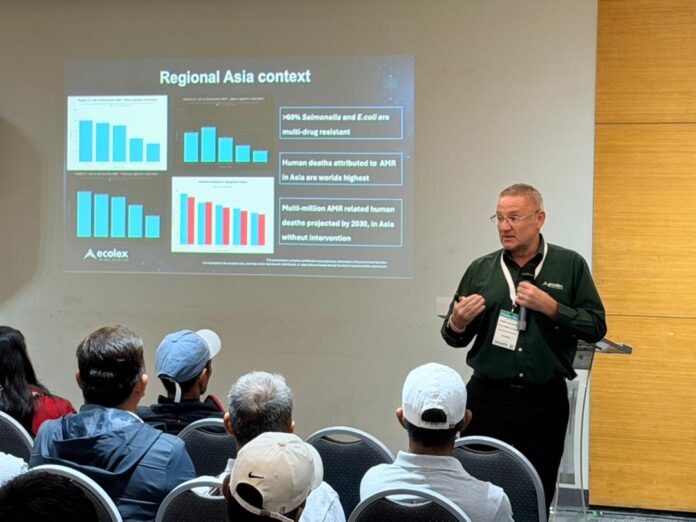
Edward Manchester, Global Business Development Director at Ecolex, delivered a keynote presentation at the ‘One Health Solutions for Sustainable Livestock Production’ Forum during Livestock Philippines 2026, reaffirming the company’s commitment to nutrition-driven One Health strategies.
In his presentation, ‘Feeding the Future Within the One Health Initiative,’ Manchester outlined how evidence-based nutrition strategies can serve as a frontline tool for achieving One Health outcomes across diverse livestock systems. He explained that ‘One Health’– a coordinated, multisectoral approach linking animal, human and environmental health – is jointly promoted by the WHO, WOAH and FAO.
Antibiotic use and mycotoxin risks
Manchester pointed to industry projections that global antibiotic use in livestock could rise by around 30 percent by 2040 if current practices continue, underscoring the urgency for the sector to adopt non-antibiotic interventions that support gut health and reduce pathogen load.
He also highlighted mycotoxins as an often-overlooked threat, noting that regional data shows positivity rates above 70–90 percent in key feed ingredients such as corn, rice bran and soybean meal across Southeast Asia. These contamination levels contribute to production losses of 5–20 percent and economic impacts of around 10–15 percent in the poultry sector.
Key topics
The session addressed:
- Strengthening gut health and immunity to reduce disease pressure
- Supporting more responsible antimicrobial use across the production cycle
- Advanced mycotoxin mitigation strategies, including humic acid and enzymatic detoxification
- Improving animal performance while reducing environmental footprint
- Linking feed formulation decisions to practical One Health outcomes at farm level
“Nutrition sits at the intersection of animal health, human health and environmental sustainability,” said Manchester. “Smarter feed formulation decisions translate into practical, measurable One Health outcomes on farm – regardless of species or market.”
He closed by reaffirming that “yesterday’s tools cannot solve tomorrow’s problems,” calling for collaboration across the animal protein value chain on One Health-aligned programs.