






























It is no secret that animal protein producers’ profit margins have been dwindling in recent years. Concerns within the agriculture sector have regularly hit mainstream news headlines around the globe. A perfect storm of geopolitical issues, the Covid pandemic, supply chain issues, and the war in Ukraine, have made for highly volatile raw material costs, pushing up the cost of production. All the while, demand for animal protein is rising, consumer focus on sustainability is increasing and the push for industries to reduce carbon emissions is greater than ever.
So how can the animal protein business be kept profitable? One approach that can lower costs, increase animal efficiency and support sustainability and environmental goals, is managing feed nutrients to formulate low-protein diets.
Feed is the biggest cost in livestock production, making up 50-70 percent of total outgoings. Among the costliest components of livestock feed is protein. Dietary protein over-supply and unbalanced diets are linked to metabolic stress and excessive nitrogen excretion. Low-protein diets with targeted amino acid (AA) supplementation have been shown to maximise growth, performance and profitability, and lower environmental impact.
Studies consistently show that each percentage point of crude protein reduced from the diet leads to an equivalent reduction of about 10 percentage points in nitrogen excretion. To achieve this reduction, an accurate understanding of the feed’s nutritional profile is of up most importance. That is why precise analysis of the quality of ingredients used in feed should be an essential part of any feed strategy.
Quality control
Precise nutrition can ensure optimal animal performance and productivity – and consequently, better return on investment. Optimising feed composition is a proven way to significantly influence animal health, meat yield, meat quality and carbon emissions. The challenge, however, comes in the variation in nutritional contents within raw materials, which can sometimes be significant; in finished feeds, raw materials are responsible for up to 70 percent of variation.
Variability is a particularly pertinent concern when we look to regions of the world experiencing unprecedented weather conditions, including floods, droughts and extreme temperatures, which heavily impact raw material quality.
Not having the tools to accurately measure and analyse the nutritional composition of raw materials can lead to overcompensation and oversupply in the diet. Surplus AA and crude protein content leads to potentially compromised animal health and increased nitrogen excretion, increasing emissions per animal.
Oversupply of nutrients also equates to an increase in cost because of unnecessarily high dietary inclusion rates of expensive protein-rich raw materials. Whereas, determining the precise nutritional composition of feed ingredients allows feed millers to formulate feeds which perfectly meet the needs of the animals. In addition, it lays the basis to make better purchasing decisions.
This is where quality control comes in. Traditionally it is something that has been carried out to catch products that are not up to specification. Today near-infrared spectroscopy (NIR) is an established tool to analyse incoming raw materials and finished feeds with minimal effort. Reliable NIR calibrations have been developed to derive relevant information on the nutritional composition, not only for proximate parameters like dry matter content and crude protein, but even on nutrients including amino acids and fatty acids. Importantly, NIR analysis can also detect where ingredients have been under- or over-processed. This is crucial, because under- and over-processing lowers AA digestibility and depletes the nutritional value of soybean products, which can result in poorer feed quality and decreased animal performance. To compensate, feed millers would have to implement high safety margins, resulting in an increase in greenhouse gas (GHG) emissions and reduced profitability.
Built on decades of science-based research and expertise, Aminonir® (Evonik) can be used at the feed mill to determine and record the precise nutritional content of feed ingredients or finished feeds, delivering reliable results in a matter of minutes. One NIR machine can easily analyse more than 10,000 ground or unground samples per year, enabling seamless quality control and building valuable data sets. These data sets can then be used to extract extra benefits beside quality control. Evaluation of the data sets will identify qualitative differences between raw materials of different geographical origins or differences between different suppliers or processing methods. These evaluations help reduce overall variation and can ensure a competitive advantage based on verifiable superior quality.
Broiler trial
Understanding the true nutritional value and energy content of raw materials can ensure accurate low-protein feed formulation, resulting in improved animal health, optimized costs, and reduced environmental impact.
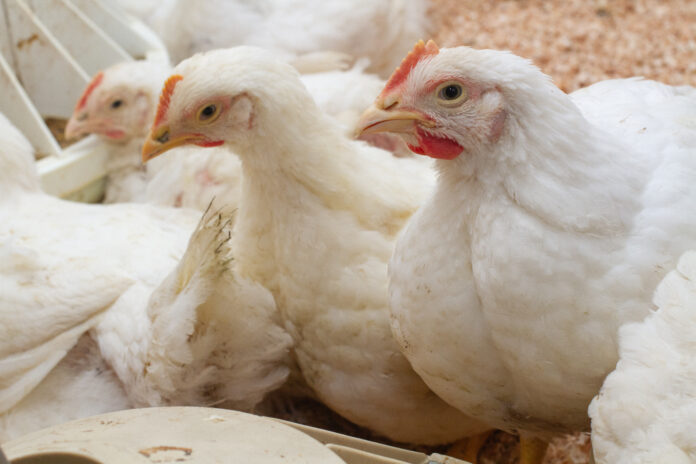
The benefit of a low-protein concept is well highlighted by the results of a 2021 feeding trial conducted by the University of Applied Sciences Osnabrück, where 205,000 broilers were fed a ‘standard’ diet and 205,000 broilers fed a protein-reduced diet. The standard diet represented the commercial standard feeds based on mainly wheat, corn and soybean meal and supplemented with DL-methionine, L-lysine sulphate, L-threonine and L-valine. The diet consisted of four feeding phases.
The protein-reduced diet included the same ingredients as standard feeds but had reduced levels of dietary protein (except for starter diets), plus digestible AA levels balanced with DL-methionine, L-lysine sulphate, L-threonine, L-valine, L-isoleucine and L-arginine.
In addition, a finisher II diet was introduced which was blended with finisher I diets at different proportions on a daily basis, with 100 percent finisher I at day 25 and 100 percent finisher II feed at days 40 to 42. The feeding regime consisted of five phases.
The study found that average final body weights across three crops was higher in protein-reduced birds (2,372g/bird) than their standard-diet-fed counterparts (2,278g/bird). Moreover, it concluded that broilers on the protein-reduced diets had a lesser impact on the environment and reduced their global warming potential.
The content of soybean meal and nitrogen was lower in the protein-reduced diets, resulting in lower ammonia emissions from the housing and manure management. The terrestrial eutrophication, which is mainly induced by ammonia emissions, showed a reduction of environmental impact by about 9 percent between the standard diet and the protein-reduced diet.
Overall, therefore, the global warming potential of the broiler flock on the reduced-protein diet was lower than of the flock on the standard diet, showing the positive impact of reducing crude protein content and using AA to achieve more targeted, effective and sustainable nutrition.
Using Evonik’s science-based Amino software solutions, such as Aminochick®, AminoHen®, AminoPig® and AminoCow®, nutritionists can determine the ideal amino acid levels to reduce crude protein intake per species and age phase, and thus reduce costs and carbon footprint. The solutions can be tailored to the demand of the animals, even down to individual flocks in individual housing conditions.
The calibrations of Aminonir® comprise of more than 60 commonly used raw materials and finished feeds covering the needs of the feed industry. The NIR calibrations are continuously updated with actual samples from all over the world. This way, relevant changes in quality and composition are picked-up and integrated into Aminonir® making it always up to date. Aminonir® delivers all the nutritional data which are needed for precise feed formulation and meeting the animal’s requirements for optimal performance. This way it is increasing resource efficiency and reducing the environmental impact of animal husbandry.
In addition to Aminonir®, Evonik is offering Aminodat®, which is the most comprehensive animal nutrition database in the world, with data of more than 278,000 feed ingredient samples and over 13,000,000 analytical results. Aminodat® is updated once per year providing an easy-to-use overview of feed ingredients per country and quality, based on a robust database. Thus, it serves as a reliable source of information and is used as reference.
Conclusion
To maximise animal health and performance and formulate feed as close to the animals’ requirement as possible, it is essential to continually monitor the quality of the raw materials that go into the animals’ diet. By gaining in-depth and real-time insights into the nutritional values of feed ingredients through NIR, feed millers and livestock producers can utilise reliable, up-to-date, scientific data to make better business decisions and improve outcomes.
These technological solutions and services can ensure the most cost-efficient and effective diets that fulfil the nutritional needs of livestock, to help maximise productivity – and ultimately, profitability.