






























by Rajinder K Bajaj, Satake India Engineering Pvt Ltd
The region of South Asia, which includes India, Pakistan, Bangladesh, Sri Lanka among others, boasts a combined population of 1.7 billion. Here, rice has traditionally been the most important staple foods in the region.
Satake India Engineering is located in the centre of this region and serving as one of the key suppliers of processing equipment for grains including rice, wheat, maize and lentils. It is also the principal distributor of Henry Simon brand flour milling equipment and technology for this region.
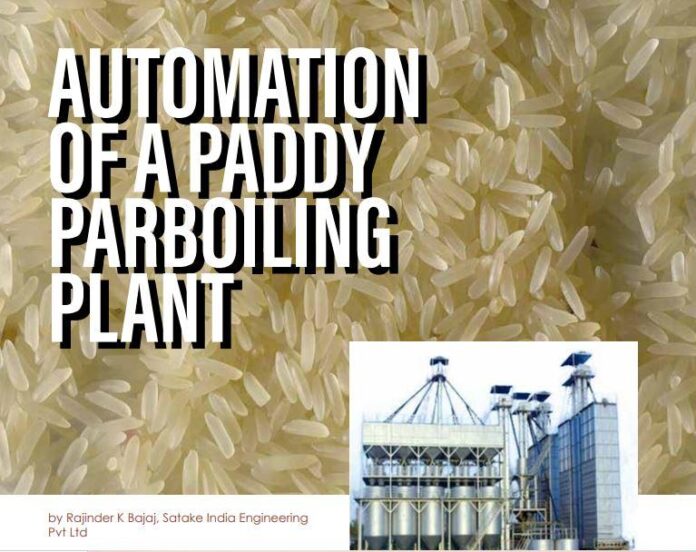
Paddy is being parboiled in India and South Asian countries for conserving its nutritional values and also for the taste factors. At present the system involves pre-cleaning, pre-steaming, paddy soaking in hot water and post-steaming, followed drying in a paddy specific facility.
All of the previously mentioned processes are currently being carried out using MS/SS tanks.
In these tanks, the main source of heat for attaining the required temperatures is largely steam. During this process the rice will be hardened, resulting in better yield during the milling process. Also, the nutrition included in the bran will penetrate into the endosperm of the grain, which will remain in the final product.
Due to these advantages, parboiled rice is consumed not only in the South Asia, but is exported to various countries around the world.
Inconsistent results
Since the system is currently mostly manually controlled using available resources, there are many sources of variation, which causes inconsistent results.
As all of the process control points and parameters are adjusted manually, there are chances of error within the batch and even amongst the various batches of the same paddy lots.
The parboiled process applied for the wet paddy, which is received from the field during the harvest season. Therefore, in this case, the process can be continued for 24 hours a day, seven days a week for several consecutive weeks.
When all of the controls are operated manually, if the level of experience of the available labour is low, then this can provide a great challenge to the mill operators.
Uncontrolled operations make the paddy vulnerable to colour variation, increased damage and burnt grains. Over cooking of paddy can also result in hardness and variations in moisture content, whilst uneven drying can also often causes yield loss in the milling process.
An automated parboiling process
Faced with these challenges, Satake India Engineering studied the current practices and developed a fully automated process for parboiling using the existing local infrastructure and Satake's world famous precision instrumentation.
Satake's main objectives are to:
- Develop a fully automated parboiling system with minimal operator engagement.
- Target consistency and repeatability within batches
- Improve error control and real time trouble shooting in case of alarms
- Use warehouse data and analytics in order to enhance process capabilities
- Implement an online feedback system to improve the batch operation process
- Log colour control data and other grain related parameters for the miller
- Save energy due to automation and a reduction in breakdowns
To achieve these targets, server-based PLC systems with embedded I/Os and SCADA systems are introduced to manage the control points, such as pneumatic slide gates, level sensors for paddy and water, control and on/off valves for steam and water, load cells, temperature and pressure sensors and transmitters and moisture sensors.
Remote viewing of the process is also enabled using IoT connectivity.
Unfortunately, the COVID-19 is still heavily hitting the wide area including South Asia region. The cross-border travelling is still restricted or limited between countries. Therefore, it will be useful if millers were to upgrade their facilities with such a system, as technology can proactively alert and solve the problems/breakdowns over remote connections.
Data collection
All data is collected and stored by a system managed by a PLC system developed specifically to manage the system automatically, with screens in the following sections of the manufacturing process:
- Pre-Steaming Section
- Paddy Soaking Tanks
- Post-Steaming Process + Pre-Drying
- Paddy Drying Section
With the help of the automation software provided, rice millers can now manage the parboiling process more efficiently and effectively. Satake India is also incorporating Next Stage Industry 4.0. technology into this application by integrating it with central cloud systems using IoT connectivity which will enable real-time monitoring of the system and its performance by the miller.
All corrections will be able to be implemented by millers in real time, allowing for the maintenance of consistent results.
Security and safety
A further feature added by Satake India is improved information security and operational safety with the employment of II-tier User Authentication system. The system's biometric login facility will only allow authorised access to the operational control, with similar systems having already been installed in leading rice millers across the region.
As a result, uniform colour and controlled parameters in grains were observed in the mills using Satake Automation Software in the parboiling process throughout this region.
Yields were also improved by error control and automation in various batches. Millers also reported that they observed a power and steam savings of us much as 30 percent, compared to their previous manually operated process.
As well as the operational improvements, the further additional benefits of the new Satake system, such as the digital analogue system data logging, ensure that the records are preserved for future reference. As a whole, capacity utilisation during the limited harvesting season, leading to an increased annual turnover of the mill.
The population in South Asia is still expanding, so is the demand for the food supply. Satake India Engineering is committed to improving the efficiency and quality of food production, thus contributing to the brighter and more prosperous future for these countries.