


by Anne-Sophie Gamborg, Content Creator, FOSS, Denmark
A barley kernel has exactly one job at the maltings: wake up. Germinate on cue and it graduates to malt, and then to beer. Hit the snooze button, staying stubbornly dormant or sprouting too eagerly out in the field, and that same kernel is demoted to animal feed, worth noticeably less. Maltsters want to see at least 95 percent of kernels sprout on cue; if it drops much below that, the whole load rolls into the feed pile.
The absurd part is that you cannot tell a sleeper from a sprinter. Badly sprouted grain shows, but the early, decisive stages of germination leave no mark on the kernel. A short burst of rain at the wrong moment can quietly tip a field over the edge while every grain still looks perfect in the hand. In other words, you cannot eyeball your way to an answer, and the standard test counts how many of a hundred grains actually wake up over about three days in a lab. By the time the result lands, the truck that delivered the load is long gone.
At a recent network meeting, a specialist from one of the network’s reference laboratories walked through exactly this puzzle and what her team is doing about it. That one technical update is a neat way into a bigger question, because this is the kind of expensive, invisible, weather-driven problem a network is built to absorb. AgroNet has been pooling harvest data since 1995. Today that means 81 connected FOSS instruments across Sweden and Norway, sharing calibrations for barley, wheat, oats, rye, triticale, rapeseed, field beans and field peas. The thread running through all of it is consistency, so a number measured on one member’s machine carries the same weight on another’s.
Everyone reads the same number
After three decades of pooling harvest data, the question worth asking out loud is this: what does being in a grain network actually buy you?
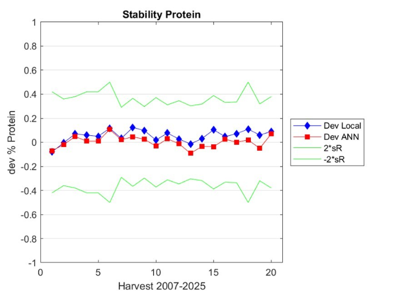
The most underrated benefit is also the most basic: every member’s instrument gives the same answer. Share one calibration, and a reading taken at your weighbridge means the same thing at your buyer’s, across the road or across a border. The effect is concrete. Take barley protein: across the network’s instruments, the typical variation between machines is a standard deviation of less than 0.1 percent. That tight agreement is the whole distance between a handshake and an argument over whose machine is lying.
None of that holds together by accident. It rests on an annual ring test against reference methods, and on a global FOSS library of more than 50,000 cross-checked wheat and barley samples, built up over decades of harvests across Europe, the Americas and Asia. The wet years, the dry ones and the genuinely strange ones are all in there. None of this is glamorous, but that is exactly the point. The same deep dataset is what keeps readings steady when a harvest turns weird, because it has seen weird before, across a far wider spread of conditions than any single region could supply.


And it is worth real money
Accurate numbers at intake are not a nicety. They decide which bin the grain goes in, and the bins are priced differently. In the UK, one of Europe’s larger malting markets, the premium for malting barley over feed swung from around EU€80 a tonne in the exceptional 2023 season to roughly EU€20 in 2025, what the market analysts call a return to the historical average rather than a collapse. Fat premium or thin, the asymmetry is the same: misread a load and you hand the whole difference away. Reading it right shows up in real operations. A 7000-hectare farm in Slovakia locked in an extra EU€5 to EU€15 a tonne by segregating its stored grain with confidence, and in one worked example, blending a 20,000-tonne shipload to a protein target was worth about EU€30,000. Same grain, sharper approach. The same logic runs straight through a flour mill: a wheat intake graded a fraction of a percent wrong on protein, or waved through on a moisture reading that does not travel between sites, follows the grain all the way to the blend, where it is far more expensive to fix than at the gate.
Fewer surprises, and a say in what comes next
There is also a quieter return, and it surfaces whenever members are asked what they get out of belonging. Being in a network means your instruments are checked and calibrated every year, so faults are caught before the season starts rather than mid-harvest, when downtime costs the most. This is the part outsiders never see: members do not just use the calibrations, they choose them. The barley-germination work mentioned earlier is a good example. It is not yet a calibration you can run in routine analysis, but a development project where the goal is a reading at the weighbridge in seconds instead of the days-long wait for the lab. Getting there takes three things a network like this already has: members willing to contribute samples, a very good reference laboratory to anchor the calibration, and, from FOSS, the calibration work that turns thousands of scans into a reading you can act on. Different countries, different priorities, one mechanism.

The part that belongs to all of us
No single farm, trader or mill could build this alone. Together, a network can. That is the real lesson of thirty harvests – the value was never one clever calibration. It is that everyone’s data, pooled and kept honest, becomes shared infrastructure that pays back the people who feed it first. Fairer prices, fewer disputes, less downtime and the occasional new capability taking shape, like learning to tell, in under a minute, whether a kernel will bother to wake up.
And if you have never signed a malting contract in your life, the barley story is still yours. Swap germination for whatever keeps you up at night, protein, oil, starch, moisture, mycotoxins and the same logic holds: everyone’s data in, a trusted answer out, identical for every member.
That is the quiet shift worth sitting with. For most of the industry’s history, analytical quality was something each site defended on its own, instrument by instrument, argument by argument. Pooled data turns it into something closer to a shared utility, where the reliability any one miller depends on is underwritten by every harvest the whole network has ever measured. A calibration is only ever as good as the grain it is built on, and the coming harvest is where that grain comes from. Whatever number your business runs on, the most valuable thing you can do with your data may be to stop keeping it to yourself.